
Oil Resistant High Flex Cable
Introduction: The Invisible Chemical Attack In manufacturing environments, cables are under constant chemical assault. Cutting fluids spray onto industrial flex cable during machining operations. Hydraulic fluid leaks drip onto cable runs near…
Introduction: The Invisible Chemical Attack
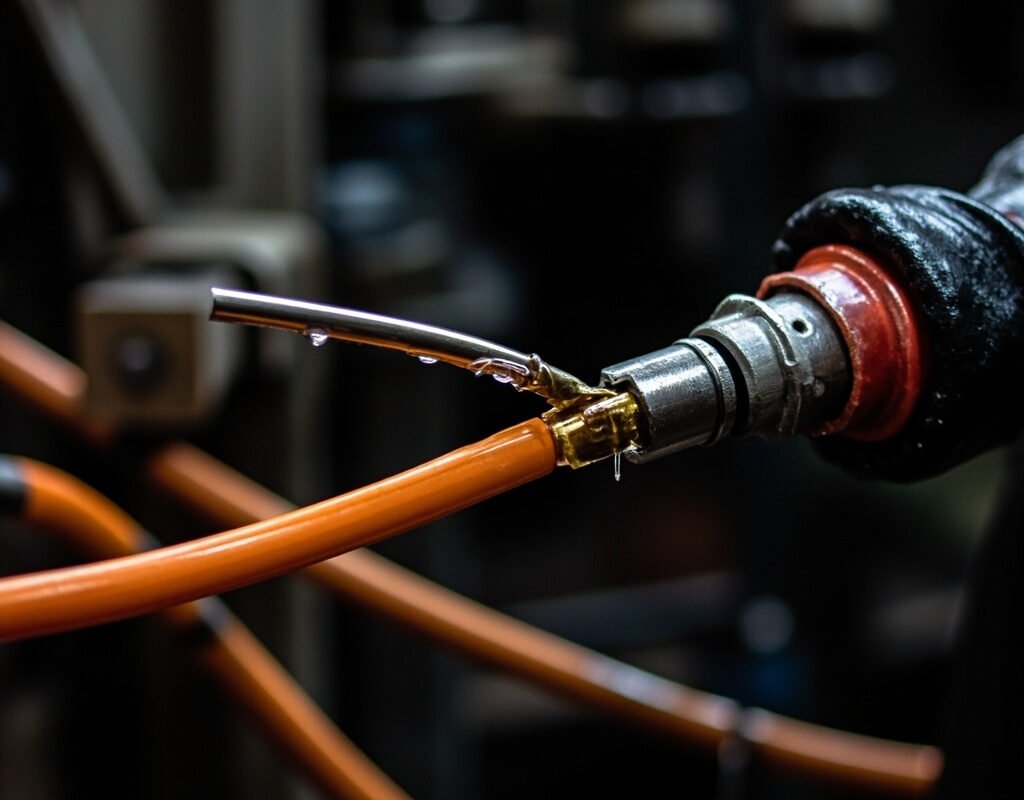
In manufacturing environments, cables are under constant chemical assault. Cutting fluids spray onto industrial flex cable during machining operations. Hydraulic fluid leaks drip onto cable runs near cylinder mounts. Gear oil splashes onto cabling around transmission housings. Cleaning solvents are applied to entire machine surfaces without regard for cable sensitivity.
The result? Cables that appeared perfectly functional during installation begin to swell, crack, and delaminate. Oil resistant high flex cable products combat this chemical assault through careful material engineering—but understanding which chemicals attack which materials is essential for successful long-term deployments.
This guide provides the chemical engineering framework for selecting cables that genuinely resist your specific process fluids.
Understanding Fluid-Polymer Interactions
The Solvation Process
When a polymer cable jacket contacts an incompatible fluid, a physicochemical process called solvation begins:
1. Fluid molecules contact polymer surface
2. Small molecules diffuse into polymer matrix (driven by concentration gradient)
3. Polymer chains swell apart as fluid fills interchain spaces
4. Volume increases → compressive stress on internal conductors
5. Physical properties degrade: hardness decreases, tensile strength falls
6. In extreme cases: jacket dissolves, conductors exposed
The key factors determining compatibility:
- Chemical similarity: “Like dissolves like” — polar fluids attack polar polymers; nonpolar fluids attack nonpolar polymers
- Molecular size: Small molecules (acetone, methanol) penetrate faster than large molecules (mineral oil)
- Temperature: Every 10°C increase approximately doubles solvation rate
- Concentration: Higher concentration = faster/more severe attack
Solubility Parameter Theory (Hildebrand Parameters)
Engineers can predict compatibility using Hansen Solubility Parameters (HSP):
Total solubility parameter δ_T = √(δ_d² + δ_p² + δ_h²)

Where:
  δ_d = dispersion component (van der Waals forces)
  δ_p = polar component
  δ_h = hydrogen bonding component

Compatibility (no swelling) when:
  Ra = √[4(δ_d1-δ_d2)² + (δ_p1-δ_p2)² + (δ_h1-δ_h2)²] < R₀

Where R₀ = interaction radius of the polymer (material-specific)
Practical implication: This explains why PUR (polyurethane) resists mineral oils (large distance in HSP space) while being attacked by aromatic solvents (similar HSP values) — without needing any experimental testing.
Fluid Types and Material Compatibility Matrix
Industrial Fluids Encountered in Automation
| Fluid Category | Example Fluids | HSP Distance to PUR | Compatibility |
|---|---|---|---|
| Hydraulic fluids (mineral-based) | ISO 32/46/68 HM, Mobil DTE | Large | ✅ Excellent |
| Synthetic esters (Group V lubricants) | Mobil SHC 526, Castrol Optigear Synthetic | Moderate | ⚠️ Good (some swelling possible) |
| Water-based emulsions (soluble oil) | Castrol Hysol, Quaker Quakercool | Large | ✅ Excellent |
| Full synthetic coolants | Fuchs Ecocool, Trim E960 | Large | ✅ Very Good |
| Aliphatic hydrocarbons (hexane, heptane) | White spirit, naphtha | Moderate | ⚠️ Moderate (concentration-dependent) |
| Aromatic hydrocarbons | Toluene, xylene | Small | ❌ Poor — avoid |
| Ketones | Acetone, MEK, cyclohexanone | Very small | ❌ Very poor — dissolves PUR |
| Esters (solvents) | Ethyl acetate, butyl acetate | Small | ❌ Poor |
| Alcohols | Methanol, ethanol, IPA | Moderate | ⚠️ Moderate (short exposure OK) |
| Acids (dilute) | HCl <10%, H₂SO₄ <10% | Large | ✅ Good |
| Bases (dilute) | NaOH <10%, KOH <10% | Large | ✅ Good |
| Chlorinated solvents | Trichloroethylene, DCM | Small-Moderate | ❌-⚠️ Varies by grade |
Material Comparison Matrix
| Jacket Material | Mineral Oil | Hydraulic Fluid | Synthetic Coolant | Aromatic Solvents | Temperature Range | Cost |
|---|---|---|---|---|---|---|
| Plasticizer-free PVC | ⚠️ Moderate | ⚠️ Moderate | ✅ Good | ❌ Poor | -15°C to +75°C | Moderate |
| Neoprene (CR) | ✅ Good | ✅ Good | ✅ Good | ⚠️ Moderate | -25°C to +90°C | Moderate |
| EPDM rubber | ✅ Good | ✅ Good | ✅ Good | ❌ Poor | -40°C to +100°C | Moderate |
| NBR (nitrile rubber) | ✅ Excellent | ✅ Excellent | ✅ Excellent | ⚠️ Moderate | -30°C to +100°C | Moderate |
| PUR (standard grade) | ✅ Excellent | ✅ Excellent | ✅ Excellent | ❌ Poor | -40°C to +80°C | Medium |
| FEP/PTFE | ✅ Excellent | ✅ Excellent | ✅ Excellent | ✅ Excellent | -65°C to +200°C | Very High |
| PVDF | ✅ Excellent | ✅ Excellent | ✅ Excellent | ✅ Very Good | -40°C to +150°C | High |
Testing Methods and Acceptance Criteria
IEC 60811 Series (Cable Material Testing)
The definitive standard series for oil resistant flex cable material qualification:
| Standard | Test | Method | Acceptance |
|---|---|---|---|
| IEC 60811-401 | Thermal aging | 7–42 days at elevated temperature | Tensile/elongation retention ≥60% |
| IEC 60811-503 | Hot set test | 200°C with 20N/cm² load applied | Elongation under load ≤175%; permanent elongation ≤15% |
| IEC 60811-601 | Specific fluid immersion | 168h immersion in customer-specific fluid | Must define own pass/fail criteria based on application |
Accelerated Testing Protocol for Custom Fluid Validation
When specifying coolant resistant cable for a new process fluid not in standard reference lists:
Step 1: Sample preparation
- Cut 50mm × 25mm jacket material specimens (3 replicates)
- Measure initial weight, dimensions, hardness (Shore A), tensile strength, elongation
Step 2: Immersion test
- Submerge specimens in 100% concentration of process fluid
- Test temperature: Maximum expected operating temperature (minimum 23°C)
- Duration: 168 hours (7 days) minimum; 1000 hours for qualification
Step 3: Post-immersion evaluation
- Allow to drain 30 min at 23°C
- Re-measure all properties immediately and after 24h recovery
Step 4: Acceptance criteria for hydraulic oil resistant cable jackets:
| Property | Acceptance Limit | Reject Criterion |
|---|---|---|
| Tensile strength retention | ≥70% | <50% |
| Elongation retention | ≥70% | <50% |
| Hardness change | Shore A ±10 | Change >15 Shore A |
| Surface condition | No cracks, blistering, or dissolution | Visible surface attack |
Real-World Application Cases
Metalworking Machining Center
Environment: CNC lathe, soluble oil coolant (10% emulsion), chips, and occasional neat cutting oil.
Failure mode observed: Original PVC cables swelling and cracking at flex points within 4 months.
Root cause: PVC plasticizers extracted by coolant, causing brittleness.
Solution: Oil resistant high flex cable with PUR jacket (oil-resistant grade, IEC 60811-404 tested at 100°C/168h: volume swell 8%, tensile retention 84%).
Result: 36+ months without replacement; MTBF improved 9×.
Hydraulic Press Manufacturing
Environment: 200-ton hydraulic stamping press, continuous hydraulic fluid (ISO VG 46 HM) contamination from fitting leaks.
Failure mode: Standard PVC cable jackets swelling around hydraulic cylinder area, causing shorts.
Solution: NBR-jacketed cables with IP67 connectors at all terminations.
Result: Zero cable failures in 24-month evaluation.
Automotive Paint Shop
Environment: Waterborne paint application, isopropyl alcohol cleaning cycles.
Failure mode observed: Cable cracking after IPA cleaning cycles.
Solution: PVDF-jacketed cables (excellent alcohol resistance, cleanroom-suitable).
Result: IPA exposure now harmless; cable service life >5 years.
Selection Decision Tree
START: What fluids will contact the cable?

├── Only water/water-based emulsions (no solvents)
│   └── PUR standard grade ✅ (most economical)
│
├── Mineral oils + water-based coolants (typical machining)
│   └── PUR oil-resistant grade ✅ (best all-around choice)
│
├── Synthetic esters or some phosphate esters
│   └── NBR or FEP ✅ (test specific fluid before committing)
│
├── Alcohols (methanol, ethanol, IPA) at high concentration
│   └── PVDF or FEP ✅ (PUR OK for dilute/infrequent exposure only)
│
├── Ketones or aromatic solvents (acetone, toluene, xylene)
│   └── FEP/PTFE only ✅ (all other materials attacked)
│
└── Multiple aggressive chemicals simultaneously
    └── FEP ✅ (broadest chemical resistance; evaluate cost justification)
Conclusion
Oil resistant high flex cable selection requires more than simply picking “oil-resistant” from a catalog description. Understanding which specific fluids contact the cable, at what temperatures and concentrations, enables engineers to select jacket materials that will genuinely resist chemical attack over the equipment’s service life. By applying the compatibility principles, testing protocols, and selection decision tree in this guide, you specify cabling that maintains integrity in even the most chemically challenging manufacturing environments.
Chemical resistance expertise from Iflexcable.