
Printing Industry Cables: High
1. Introduction: Why Printing Presses Demand Specialized Cabling The commercial printing industry has undergone profound technological transformation over the past two decades. From traditional sheet-fed offset presses running at 15,000 sheets per…
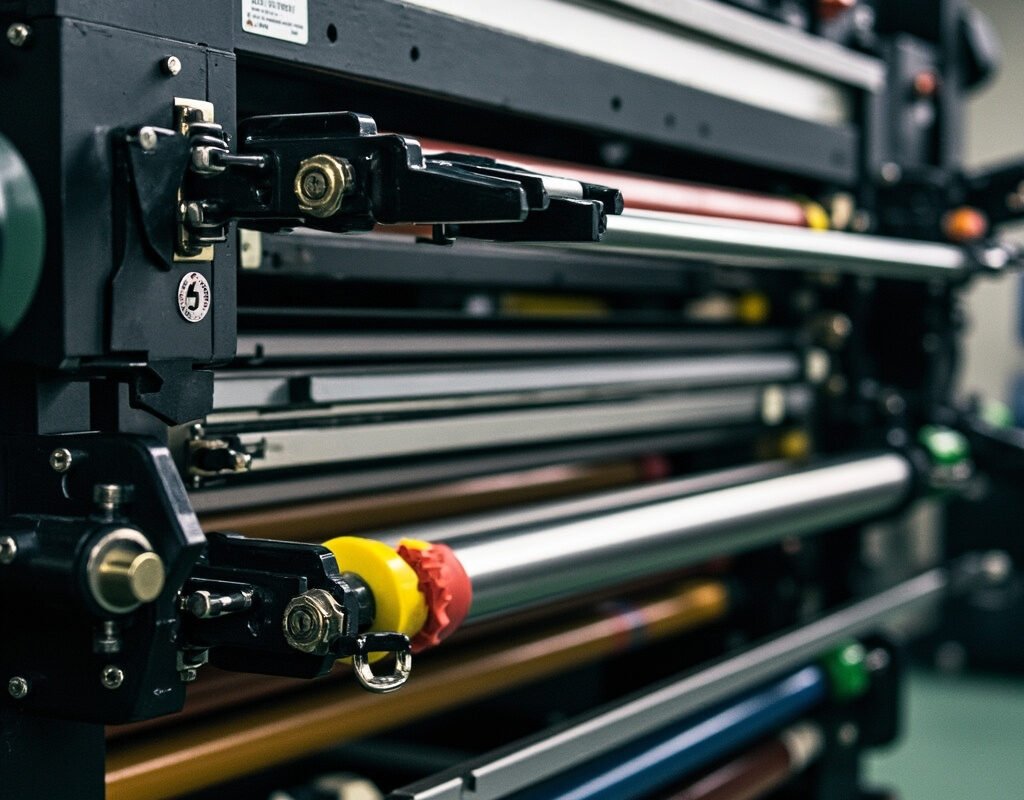
1. Introduction: Why Printing Presses Demand Specialized Cabling
The commercial printing industry has undergone profound technological transformation over the past two decades. From traditional sheet-fed offset presses running at 15,000 sheets per hour to today’s hybrid digital/inkjet systems capable of variable-data printing at web speeds exceeding 200 meters per minute, the electrical and electronic complexity of printing equipment has increased exponentially.
Along with this sophistication comes a uniquely hostile environment for cables and wires:
- Solvent-based inks and washup solutions (ethyl acetate, ethanol, MEK, IPA) aggressively attack standard cable jacket materials
- UV curing systems generate intense ultraviolet radiation and ozone that degrade many polymers
- Powder spray anti-setoff systems deposit fine particulate that abrades and penetrates cable jackets
- High-speed reciprocating motion in ink key motors, blanket cylinder mechanisms, and delivery systems demands exceptional flex endurance
- Electromagnetic interference from multiple servo-driven axes, UV ballasts, and high-frequency drying systems threatens signal integrity
A poorly specified cable on a modern eight-color offset press can fail in as little as 2–4 months, triggering press downtime costing $2,000–$8,000 per hour in lost production. Conversely, a properly engineered printing industry cable delivers reliable operation across a 5–10 year press lifetime, representing one of the highest-ROI investments in the entire press outfitting budget.
Iflexcable brings decades of specialized experience in printing industry cable solutions, serving leading press manufacturers including Heidelberg, Komori, Manroland, HP Indigo, EFI, and countless others through OEM partnerships and aftermarket supply channels.
2. Cable Requirements by Printing Process Type
2.1 Offset Lithography (Sheet-Fed & Web Offset)
Offset printing remains the dominant process for high-volume commercial printing, and it presents some of the most challenging conditions for industrial cabling:
Ink Fountain & Dampening System Cables:
- Exposed to fountain solution (isopropyl alcohol + water mix, typically 8–15% IPA)
- Subject to ink mist and spray during makeready and washup cycles
- Ink fountain roller adjustment motors execute precise positioning movements
- Recommended: Chemically resistant PUR or TFE (PTFE) jacketed servo cables with IP67-rated connector terminations
Ink Key Motor Arrays:
- Modern sheet-fed presses feature 20–26 individually adjustable ink keys across the print width
- Each ink key motor requires power and serial communication (CANopen or similar fieldbus)
- Cables are bundled tightly together in the inking unit duct
- Heat generation from concentrated motor density raises local temperature
- Recommended: Miniature high-density multi-conductor cable (0.25–0.34mm²) with individual pair shielding for data lines, thin-wall TPE-E insulation for space efficiency
Blanket Cylinder & Impression Cylinder Mechanisms:
- High-torque servo motors for cylinder pressure adjustment and lateral register
- Large-gauge power cables (2.5–6mm²) for main drive motors
- Encoder feedback cables requiring excellent noise immunity
- Recommended: Shielded servo drive cables with double-layer insulation (inner XLPE, outer TPE-E)
Delivery System Cables:
- Non-stop pile transfer mechanisms with complex synchronized motion
- Powder spray system actuators (anti-setoff powder distribution)
- Dynamic counter-rotating suction wheels for sheet separation
- Recommended: Medium-flex control cables with oil/PUR resistant jacket, minimum IP54 protection level
2.2 Flexographic Printing (Narrow Web, Wide Web, Corrugated)
Flexo printing introduces additional considerations:
Solvent-Based Ink Systems:
- Many narrow-web flexo presses (label printing) use solvent-based inks (UV-curable or evaporative)
- Washup solvents include ethyl acetate, n-propyl acetate, ethanol, and MEK
- These solvents rapidly degrade PVC, standard TPE, and even some grades of PUR
- CRITICAL: Only fluoropolymer (FEP, PTFE) or specialized solvent-resistant PUR grades survive prolonged solvent exposure
Web Handling & Tension Control:
- Unwind/rewind turret systems with dancer roller feedback
- Load cell tension measurement signals requiring high-precision analog transmission
- Web guiding systems with edge-detection sensors and ultrasonic positioners
- Recommended: Low-capacitance shielded instrumentation cable for analog tension signals; high-flex data cable for encoder/web guide communication
Corrugated Flexo (Post-Printing):
- Extremely wide machines (up to 3.5 meters print width)
- Very long cable runs (control cabinet often 15–30 meters from print units)
- Heavy-duty AC motors for feed conveyor and slotter/die-cutter integration
- Recommended: Tray cable (TC-ERP rated) for power runs; repeater/amplifier consideration for data signals beyond 25 meters
2.3 Digital Printing (Inkjet, Electrophotography, Toner-Based)
Digital presses (HP Indigo, Kodak Nexpress, Canon ImagePress, Konica Minolta Accurio, Xerox iGen) have their own distinct cabling requirements:
Inkjet Printhead Cables:
- Extremely high data rates (multi-Gbps for modern piezoelectric printheads)
- Must maintain signal integrity over relatively short but flexing distances (printhead carriage travel)
- Often proprietary or semi-proprietary interfaces requiring matched-impedance cabling
- Recommended: Specialized high-speed data cable with controlled impedance (typically 100Ω differential), often supplied by printhead OEM — third-party alternatives available for aftermarket
Toner Development & Transfer Systems:
- High-voltage bias supplies (500V–1500V DC) for electrostatic transfer
- Corona charging wires and scorotron assemblies
- CRITICAL: These systems require dedicated high-voltage rated cable (minimum 2kV dielectric withstand, preferably 5kV+) with shielded construction. Standard control cables will fail catastrophically (arc tracking, insulation breakdown) when used for HV bias connections
Paper Path Sensors & Registration:
- Optical sensors, ultrasonic detectors, and electrostatic registration sensors
- Long signal runs through paper path with proximity to high-voltage components
- Recommended: Highly shielded (double-shielded) low-capacitance sensor cable with isolated drain wire
2.4 Packaging Printing & Converting
Packaging converting equipment combines printing with additional processes:
- Lamination stations: nip rollers with heated platens, adhesive application
- Die-cutting stations: rotary dies with high cutting forces, vibration
- Foiling/stamping units: heated stamping heads (up to 150–200°C platen temperature locally)
- Slitting/rewinding: razor slitters, shear knives, tension control
- Inspection systems: high-resolution line-scan cameras (Camera Link or GigE Vision interface)
Cable requirements here represent the union of ALL previous categories — chemical resistance, thermal resistance, flex endurance, EMI shielding, and high-speed data transmission — often within a single machine envelope.
3. Material Science: Chemical Compatibility Deep-Dive
3.1 Printing Solvent Compatibility Matrix
The following table summarizes jacket material compatibility with common printing industry chemicals:
| Chemical / Solvent | PVC | TPE | PUR (Std) | PUR (SR)* | FEP/PTFE |
|---|---|---|---|---|---|
| Ethanol | Fair | Good | Good | Excellent | Excellent |
| Ethyl Acetate | Poor | Poor | Marginal | Good | Excellent |
| n-Propyl Acetate | Poor | Poor | Poor | Fair | Excellent |
| Methyl Ethyl Ketone (MEK) | Poor | Poor | Poor | Marginal | Excellent |
| Toluene | Poor | Poor | Poor | Fair | Excellent |
| Mineral Oil (ink vehicle) | Poor | Good | Good | Excellent | Excellent |
| UV Ink Oligomers | Poor | Marginal | Fair | Good | Excellent |
| Fountain Solution (IPA+water) | Fair | Good | Good | Excellent | Excellent |
| Blanket Wash (glycol ether) | Poor | Marginal | Fair | Good | Excellent |
| Powder Spray (starch/PP) | Good | Good | Good | Excellent | Excellent |
\* SR = Solvent-Resistant grade (special formulation)
Key insight: For any application involving ester-based solvents (ethyl acetate, nPA — ubiquitous in flexo label printing), fluoropolymer (FEP/PTFE) or specially formulated solvent-resistant PUR is mandatory. There is no acceptable middle ground.
3.2 UV & Ozone Resistance
UV curing systems used in modern offset and flexo presses emit intense ultraviolet radiation (primarily UVA at 365nm and UVC at 254nm) that generates ozone as a secondary byproduct. Both UV radiation and ozone aggressively degrade many polymers:
Material Degradation Rate under UV/Ozone Exposure:
| Material | Surface Cracking (months) | Tensile Strength Loss (12 mo.) | Suitability for UV Zone |
|---|---|---|---|
| Stabilized PVC (UV) | 6–12 | 20–30% | ⚠️ Marginal |
| Standard PUR | 3–6 | 30–40% | ⚠️ With distance/shielding |
| Carbon-black filled PUR | 12–24+ | <10% | ✅ Good |
| FEP / PTFE | Essentially infinite | <2% | ✅ Excellent |
| Silicone rubber | 6–12 | 15–25% | ✅ Acceptable |
Installation recommendation: Maintain minimum 500mm clearance between non-UV-rated cables and UV curing lamps. Where closer proximity is unavoidable, use black carbon-filled PUR or fluoropolymer cables exclusively.
4. Technical Specifications: What to Look For
4.1 Essential Specifications Checklist
When evaluating printing industry cables, verify the following parameters:
| Parameter | Minimum Acceptable | Preferred (Premium) | Test Method |
|---|---|---|---|
| Flex cycles (DIN VDE) | >2 million | >10 million | DIN VDE 0285-2 |
| Bend radius (dynamic) | ≤10×OD | ≤6×OD | Manufacturer spec |
| Operating temperature | -10°C ~ +80°C | -25°C ~ +105°C | IEC 60811-401 |
| Oil resistance (IRM 902) | ΔV < +30% (7 days/70°C) | ΔV < +10% | IEC 60811-404 |
| Chemical compatibility | Per application matrix | Full matrix compliant | IEC 60811-404 |
| Flame retardancy | IEC 60332-1 | IEC 60332-1C (bundled) | IEC 60332 series |
| Shield coverage | 80%+ (where required) | 85%+ braid or foil+braid | IEC 61196 |
4.2 Iflexcable Printing Cable Product Matrix
| Series | Target Application | Key Feature | Conductor Range | OD Range |
|---|---|---|---|---|
| GRX-PR-SOLV | Flexo solvent environment | Solvent-resistant PUR/FEP | 0.14–1.5mm² | 3.8–11.2mm |
| GRX-PR-UV | UV curing zone | Carbon-black filled, ozone resistant | 0.14–2.5mm² | 4.5–15.0mm |
| GRX-PR-DIG | Digital press/inkjet | Controlled impedance, high-speed data | AWG 24–AWG 22 pr | 5.0–9.0mm |
| GRX-PR-HV | High-voltage bias (electrostatic) | 5kV rated dielectric | 0.5–1.5mm² | 3.5–8.0mm |
| GRX-PR-HYBRID | Multi-function zones | Power + data + pneumatic combo | Mixed | 8.0–22.0mm |
All series are available with custom lengths, color coding, marking/printing, and connector termination options.
5. Installation & Maintenance Guidelines
5.1 Pre-Installation Inspection
Before installing any cable on printing equipment:
- Visually inspect the full cable length for kinks, abrasions, or compression damage from shipping
- Verify conductor continuity and insulation resistance using a multimeter (insulation resistance >100 MΩ at 500VDC)
- Confirm cable matches specification printed on the reel tag (cross-check part number against purchase order)
- Check jacket condition — soft spots or discoloration indicate possible storage degradation (especially important for PUR cables stored >2 years)
5.2 Routing During Press Assembly
- Route cables away from hot surfaces (drying cylinders, UV lamps, heated platens) — maintain ≥150mm clearance where feasible
- Separate power and signal cables by at least 50mm, or cross them at 90° angles only
- Support cables at regular intervals (≤400mm for horizontal runs, ≤300mm for vertical drops)
- Avoid sharp edges and corners — use protective grommets or edge guards with minimum 5mm radius
- Leave 5–8% slack in moving cable sections to accommodate thermal expansion and mechanical tolerances
- Document cable routing with photographs for future maintenance reference
5.3 Preventive Maintenance Schedule
| Interval | Task | Details |
|---|---|---|
| Weekly | Connection check | Retorque terminal blocks in control cabinet |
| Monthly | Cable carrier inspection | Clean debris, check for link wear, verify smooth operation |
| Quarterly | Insulation resistance test | Megger test critical circuits (>100 MΩ @ 500VDC) |
| Annually | Flex section replacement assessment | Inspect high-motion cables for jacket cracking, stiffness changes |
| As needed | Post-incident inspection | After any jam, crash, or abnormal event — inspect all affected cables |
5.4 Troubleshooting Guide
| Symptom | Probable Cause | Diagnostic Step | Remedy |
|---|---|---|---|
| Encoder position drift | Shield damage / grounding issue | Measure shield continuity | Re-terminate or replace cable |
| Communication errors (fieldbus) | EMI ingress / impedance mismatch | Spectrum analyzer check | Improve separation, add ferrite cores |
| Short circuit trip | Insulation breach (chemical/mechanical) | Insulation resistance test | Locate breach point, replace cable |
| Premature jacket cracking | UV/ozone degradation or chemical attack | Visual + material analysis | Replace with chemically appropriate grade |
6. Cost-Benefit Analysis: Premium vs. Standard Cable
Let’s examine a realistic cost comparison for a mid-size six-color sheet-fed offset press:
Scenario Parameters:
- Press model: 6-color B1 format (70cm × 100cm), max speed 15,000 sph
- Estimated cable quantity: 180 cables of various types and lengths
- Expected press service life: 12 years (typical for well-maintained offset press)
- Downtime cost: $3,500/hour (average revenue loss + makegood costs)
- Average production: 18 hours/day, 320 days/year
Cost Comparison:
| Cost Category | Standard Industrial Cable | Iflexcable PR Series (Premium) |
|---|---|---|
| Installation labor | Included (same) | Included (same) |
| Expected annual cable failures | 8.4 incidents (avg.) | 0.6 incidents (avg.) |
| Avg. repair downtime per incident | 3.5 hours | 2.0 hours (faster diagnosis) |
| Annual downtime cost | $105,840 | $4,200 |
| Replacement parts cost (annual) | $4,200 | $480 |
| 12-year TCO | $1,447,080 | $245,760 |
| Net savings (premium option) | — | $1,201,320 saved over 12 years |
ROI Calculation:
Additional Initial Investment: $19,800 - $12,600 = $7,200
Annual Savings: $1,447,080/12 - $245,760/12 = $100,110/year
Payback Period: $7,200 / $100,110 = 0.072 years = 26 DAYS
The payback period for premium printing cables is measured in weeks, not years. This is not a marginal improvement — it is a transformative economic decision.
7. Regulatory & Safety Considerations
7.1 Fire Safety in Printing Plants
Printing facilities store significant quantities of flammable materials (paper, solvents, inks, cleaning agents). Cable fire performance is therefore a critical safety consideration:
Flame Spread Ratings:
- IEC 60332-1: Single vertical flame test — minimum requirement for industrial cables
- IEC 60332-1C: Bundled cable flame test (more stringent) — required for densely packed cable trays in press rooms
- IEC 60331: Circuit integrity under fire (maintains circuit operation for defined period during fire) — essential for fire pump, emergency shutdown, and smoke extraction circuits
Low Smoke Zero Halogen (LSZH):
- LSZH cables (IEC 60754-1/-2 compliant) produce minimal smoke and no toxic halogen gases when burned
- Strongly recommended for enclosed press rooms and below-floor cable trenches
- All Iflexcable GRX-PR-LSZH variants meet IEC 60754, IEC 61034 (smoke density), and IEC 60332-1C standards
7.2 Electrical Safety (Shock Hazard Prevention)
Printing presses involve the dangerous combination of conductive liquids (fountain solution, blanket wash) and high voltages (electrostatic assist systems, corona chargers). Cable selection must account for:
- Adequate insulation thickness and dielectric rating for voltage level
- Proper IP rating at termination points (IP65 minimum in wet zones)
- Grounding/bonding of all metallic shields and conduits
- GFCI/RCD protection for circuits in wet areas
8. Emerging Trends in Print Industry Cabling
8.1 Industry 4.0 & Connected Presses
Modern “smart” presses integrate extensive sensor networks for real-time quality monitoring (spectrophotometric color measurement, sheet registration, coating weight). This drives demand for miniature multi-sensor cables combining power (for active sensors) and data (digital output) in very small cross-sections (3–5mm OD).
8.2 Additive Manufacturing (3D Printing) Integration
Some innovative printers are integrating inkjet or aerosol jet deposition of functional materials (conductive inks, dielectric coatings) onto printed substrates — blurring the boundary between printing and electronics assembly. These applications require novel cable types that combine precision fluid handling with signal transmission in compact form factors.
8.3 Sustainability & Environmental Compliance
Growing regulatory pressure (EU EcoDesign Directive, extended producer responsibility) pushes toward:
- Halogen-free (HF) cable constructions
- Recyclable or bio-based polymer jackets
- Reduced material consumption through miniaturization
- Extended service life reducing waste generation
Iflexcable actively invests in sustainable cable development, with halogen-free and recycled-content options available across our printing cable portfolio.
9. Conclusion: The Strategic Value of Proper Print Cabling
The printing industry operates on thin margins where every hour of uptime counts. A comprehensive cable strategy — selecting the right materials, specifications, and installation practices — is not an area where cost-cutting makes sense. The numbers unequivocally demonstrate that premium, application-engineered cables from Iflexcable deliver returns measured in thousands of percent over the equipment lifecycle.
Whether you operate a quick-print shop with a single digital press or a large commercial printer running multiple web offset lines around the clock, proper cabling is foundational to your operational success. Our team of printing industry specialists is ready to help you audit your current cabling infrastructure, recommend upgrades, and supply the exact products you need.
Contact Iflexcable Today:
- Technical consultation and application engineering support
- Free cable sample program for evaluation
- Custom cable design for unique press configurations
- Global shipping with competitive lead times
- After-sales support and warranty service
Invest in reliability. Invest in Iflexcable printing industry cables.
Last Updated: April 2026 | Iflexcable — Precision Cabling for the Printing Industry
Applicable Standards: IEC 60228, IEC 60227, IEC 60332, IEC 60754, UL 62, NFPA 79, EN 50525