
Submersible High Flex Cable
Introduction: When Water Is Not an Intruder but the Operating Environment Most cable specifications treat water as a hazard—an intrusion to be prevented. But for submersible high flex cable applications, water IS…
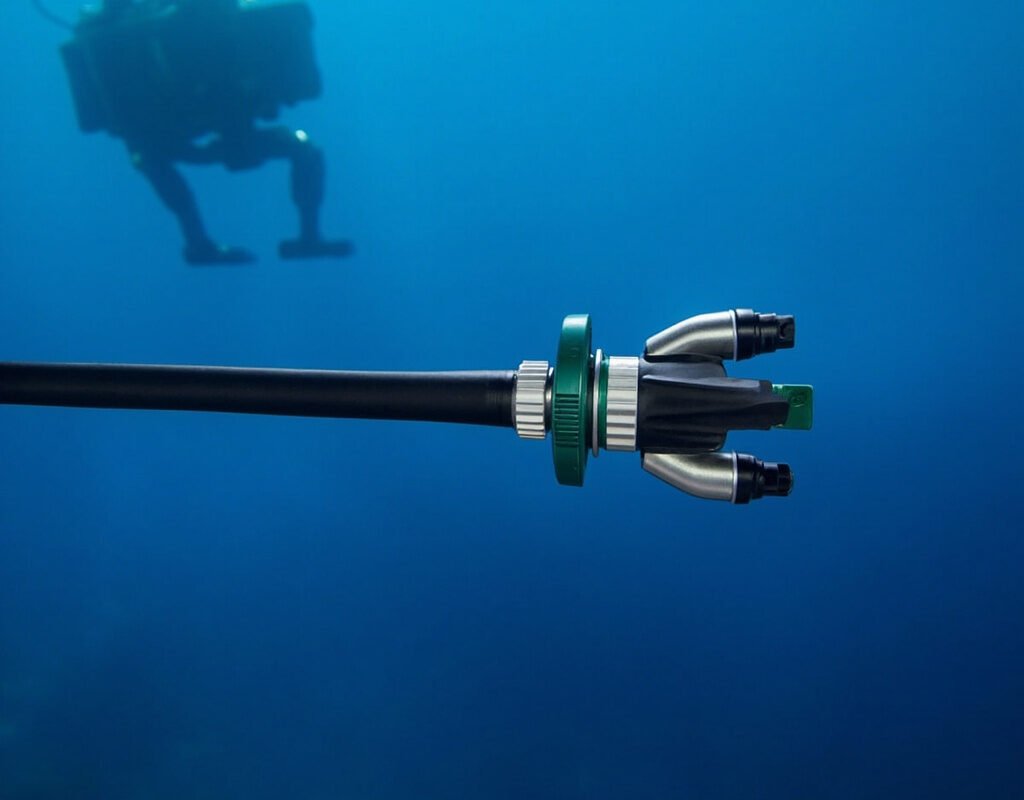
Introduction: When Water Is Not an Intruder but the Operating Environment
Most cable specifications treat water as a hazard—an intrusion to be prevented. But for submersible high flex cable applications, water IS the operating environment. Subsea sensors, underwater robotics, wastewater treatment equipment, aquaculture systems, and flood-prone industrial installations require cables engineered specifically for continuous or intermittent submerged operation while maintaining flexibility for dynamic motion.
A waterproof flex cable that works perfectly on a dry factory floor may fail catastrophically within weeks of submersion—not necessarily from immediate water ingress, but from slow degradation mechanisms that unfold invisibly over time: hydrolysis, osmotic blistering, cathodic delamination, and pressure-driven permeation.
This guide provides the engineering foundation for specifying cables that genuinely survive and thrive in wet and submerged environments.
Water Ingress Mechanisms and Protection Strategies
How Water Enters (and Destroys) Cables
Water ingress pathway model:

WATER CONTACT
    │
    ├── Micro-defects in jacket (pinholes, manufacturing voids)
    ├── Cut/abrasion damage exposing underlying layers
    ├── Connector/cable interface (most common failure point!)
    ├── End termination (if not properly sealed)
    │
    ▼
CAPILLARY ACTION along conductor strands
    │
    ├── Wicks deep into cable interior (can travel meters from entry point)
    │
    ▼
DEGRADATION MECHANISMS:
    ├── Hydrolysis: Water molecules break polymer chains
    │   → PVC softens, loses tensile strength
    │   → Some polyurethanes degrade (hydrolytic instability)
    │   → PET separator tapes weaken
    │
    ├── Corrosion: Copper conductors oxidize/resistivity increases
    │   → Voltage drop increases
    │   → Eventual open circuit
    │
    ├── Osmotic blistering: Dissolved salts create osmotic pressure differential
    │   → Blisters form beneath jacket
    │   → Accelerates crack propagation
    │
    ├── Ice formation: Freezing water expands ~9% by volume
    │   → Cracks jacket from inside
    │   → Creates new pathways for further ingress
    │
    └── Dielectric breakdown: Water reduces insulation resistance
        → Leakage currents → short circuits → ground faults
The Defense-in-Depth Model
Reliable underwater flexible cable design applies multiple protective barriers:
| Barrier Layer | Mechanism | Effectiveness Against… |
|---|---|---|
| Inner sheath or wrap | Secondary moisture barrier (foil/polyester) | Residual moisture that penetrates jacket |
| Water-blocking filler | Swellable powder/tape that expands on water contact | Capillary wicking along conductors |
| Water-resistant insulation | Hydrophobic insulation material | Direct conductor contact with any water |
| Filled/gel-filled construction | Thixotropic gel floods all voids | Eliminates air/water migration paths entirely |
| Proper termination | Sealed connector or potting head | THE most critical barrier—most failures occur here |
IP Rating Deep Dive: Beyond the Basics
Understanding IP68 Correctly
IP68 is frequently misunderstood. It does NOT mean “waterproof to infinite depth forever.” The actual definition:
IP68 Definition (IEC 60529):
"Dust tight; protected against the effects of continuous immersion in water
under conditions which shall be agreed between manufacturer and user,
but which are more severe than for IPX7."

KEY INSIGHT: IP68 is a NEGOTIATED specification!
├── Manufacturer specifies BOTH depth AND duration
├── Example: "IP68: 10 meters for 30 days"
├── Another example: "IP68: 100 meters for 24 hours"
├── These are NOT interchangeable!
│
Common submersible cable IP68 ratings:
├── Light duty: IP68 @ 1m for 7 days (occasional flooding)
├── Medium duty: IP68 @ 10m for 30 days (frequent submersion)
├── Heavy duty: IP68 @ 50m for extended period (continuous underwater)
└── Extreme: IP68 @ 300m+ (deep-water applications; special construction required)
IP69K: High-Pressure, High-Temperature Water Jet
For waterproof flex cable exposed to washdown cleaning:
IP69K Definition (DIN 40050-9):
"Able to withstand high-pressure (80-100 bar) and high-temperature
(80°C) water jet cleaning from close range (10-15cm) at various angles."

Applications: Food processing equipment, pharmaceutical clean-in-place,
outdoor mining equipment, vehicle underbody exposure.
Important: IP69K does NOT imply submersion capability! Many IP69K-rated cables are designed for spray resistance, not immersion. For combined spray + submersion, specify both IP69K AND IP68.
Pressure Compensation: The Deep-Water Challenge
Why Depth Matters
Every 10 meters of water depth adds approximately 1 atmosphere (101.3 kPa, ~14.7 psi) of external pressure:
| Depth | Pressure (absolute) | Pressure (gauge) | Design Implications |
|---|---|---|---|
| 10m | 2 atm | 1 atm | IP68 light duty |
| 50m | 6 atm | 5 atm | Medium-duty submersible cable |
| 100m | 11 atm | 10 atm | Heavy-duty construction needed |
| 200m | 21 atm | 20 atm | Specialized deep-water cable |
| 500m | 51 atm | 50 atm | Oceanographic/oil & gas grade |
| 1000m | 101 atm | 100 atm | ROV/towed array grade |
| 6000m (Mariana Trench) | 601 atm | 600 atm | Specialized research vehicles only |
Pressure Effects on Cable Construction
At depths beyond ~50m, unpressurized submersible cable experiences:
- Jacket compression: Polymer jackets compress; wall thickness effectively decreases
- Void collapse: Any air pockets or foam fillers collapse permanently
- Conductor compaction: Stranded conductors compress together
- Insulation thinning: Insulation around conductors thins under pressure
- Differential pressure risk: If ANY internal void exists (air bubble from manufacturing), external water pressure will drive water inward through microscopic defects
Solution options for deep-water applications:
| Approach | How It Works | Depth Limit | Pros/Cons |
|---|---|---|---|
| Solid-fill / gel-filled | All voids filled with non-compressible gel | 100m | Simple; limited depth |
| Fully solid construction | No voids whatsoever (tight-tolerance extrusion) | 50m | Most economical; simplest |
| Metal armor with crush rating | Steel wire braid/armoring resists crushing | 200m+ | Adds weight; protects from physical damage too |
Material Science for Aquatic Environments
Jacket Materials for Submersible Applications
| Material | Water Absorption (24h, 23°C) | Hydrolytic Stability | Long-term Submersion Suitability | Notes |
|---|---|---|---|---|
| PUR (polyether type) | 0.3–1.0% | GOOD | ✅ Good for 5–10 years | Preferred for dynamic submersible applications |
| PUR (polyester type) | 0.5–1.5% | POOR | ❌ Avoid for long-term submersion | Hydrolyzes in warm water |
| TPU (specific grades) | <0.5% | Very Good | ✅ Excellent | Best choice for demanding submersible flex cable |
| Hypalon (CSM) | <0.2% | Excellent | ✅ Excellent (10–20 years) | Marine industry standard |
| Neoprene (CR) | 0.3–0.8% | Good | ✅ Good | Proven marine track record |
| FEP/PTFE | <0.01% | Exceptional | ✅ Outstanding | Ultimate water barrier; expensive |
| Rubber (EPR) | 0.5–1.0% | Good | ✅ Good | Traditional submersible insulation |
| LSZH (EVA-based) | 0.5–1.5% | Fair-Good | ⚠️ Evaluate case-by-case | Some grades excellent, some poor |
CRITICAL DISTINCTION: Polyether-based PUR has good hydrolytic stability. Polyester-based PUR does NOT. Always confirm the base polyol chemistry when specifying submersible high flex cable with PUR jacket.
Conductor Protection for Wet Environments
| Conductor Treatment | Protection Mechanism | Cost Premium | Recommended For |
|---|---|---|---|
| Tinned copper | Sn plating slows corrosion | +5–10% | Humid environments; general-purpose submersible |
| Silver-plated copper | Superior corrosion resistance; lower contact resistance | +30–50% | Critical signal integrity; seawater applications |
| Nickel-plated copper | Excellent high-temp corrosion resistance | +20–40% | High-temperature submersible |
| Enamel/coated (magnet wire style) | Complete polymer barrier | +15–25% | Specialty applications |
For underwater flexible cable in salt water environments, tinned copper minimum; silver-plated recommended for critical circuits.
Application Domains
Underwater Robotics (ROV/AUV)
Remotely Operated Vehicles (ROVs) and Autonomous Underwater Vehicles (AUVs) represent one of the most demanding submersible cable applications:
| Requirement | Typical Spec | Reason |
|---|---|---|
| Tether strength | 5–50 kN breaking load | Vehicle recovery load + safety factor |
| Electrical conductors | Power + data + video | Real-time control and telemetry |
| Fiber optic channels | Single-mode or multimode | High-bandwidth data/video |
| Neutral buoyancy | Specific gravity ~1.0–1.1 | Reduces drag and vehicle power consumption |
| Flexibility | Must deploy from winch/reel system | Repeated coiling/deployment cycles |
| Abrasion resistance | Seabed contact; marine growth | Ocean floor hazards |
Wastewater and Water Treatment
| Application | Environment | Key Requirements |
|---|---|---|
| Sludge mixer/agitator cables | Continuous submerged; abrasive slurry | Extreme abrasion resistance; constant flexing |
| UV disinfection unit cables | Intermittent splash/submersion | UV-resistant jacket; IP68 rated |
| Sensor/instrumentation cables | Continuous submerged; clean water | Signal integrity; long-term reliability |
| Actuator/valve cables | Intermittent submersion; outdoor | Weather resistance + occasional flooding |
Flood-Prone Industrial Installations
For ground-level installations where flooding is possible but not normal operation:
| Scenario | Recommended Rating | Rationale |
|---|---|---|
| Seasonal flooding (shallow, <1m) | IP68 @ 1m, 7-day rating | Survives flood duration without degradation |
| Potential flash flood | IP68 @ 3m, 30-day rating | Accounts for unpredictable depth/duration |
| Coastal/storm surge area | IP68 + salt-water compatible materials | Saltwater flooding accelerates corrosion |
Termination: The Weakest Link
No waterproof flex cable is more waterproof than its weakest termination:
Termination hierarchy (best to worst):

Tier 1: MOLDED/POTTED termination
├── Cable-gland assembly potted with epoxy or polyurethane resin
├── Complete environmental seal; IP68 achievable
├── Permanent (non-repairable in field)
└── Used for: Deep-sea instruments, permanent underwater installations

Tier 2: PROFESSIONAL gland + proper preparation
├── Industrial IP68/IP69K rated cable gland (e.g., Hawke, Cablecraft, Kelm)
├── Multi-part sealing diaphragm grips both cable OD and individual conductors
├── Field-serviceable with proper tools and training
└── Used for: Industrial equipment, outdoor panels, marine applications

Tier 3: Standard IP65-67 gland
├── Single-seal compression gland
├── Adequate for spray/splash; marginal for submersion
├── Field-serviceable
└── Used for: General industrial; light water exposure

Tier 4: Improvised / consumer-grade
├── Duct tape, silicone sealant, heat shrink without adhesive
├── NOT reliable for any submersion scenario
└── NEVER use for: Anything where water contact is expected
Conclusion
Submersible high flex cable specification requires systematic evaluation of depth, duration, water chemistry, motion profile, and termination quality—not simply selecting a product labeled “waterproof.” By understanding the mechanisms of water-induced degradation, the meaning behind IP ratings, the importance of material hydrolytic stability, and the critical role of proper termination, engineers specify underwater cabling systems that deliver reliable, long-term performance in the world’s most challenging aquatic environments.
Underwater and submersible cable technology from Iflexcable.