Outdoor UV Resistant Cable
Introduction: The Silent Destroyer — Ultraviolet Radiation Billions of dollars worth of installed cable infrastructure silently degrades under UV radiation. Unlike dramatic failures from crushing or flooding, UV-induced degradation progresses insidiously—jackets lose…
Introduction: The Silent Destroyer — Ultraviolet Radiation
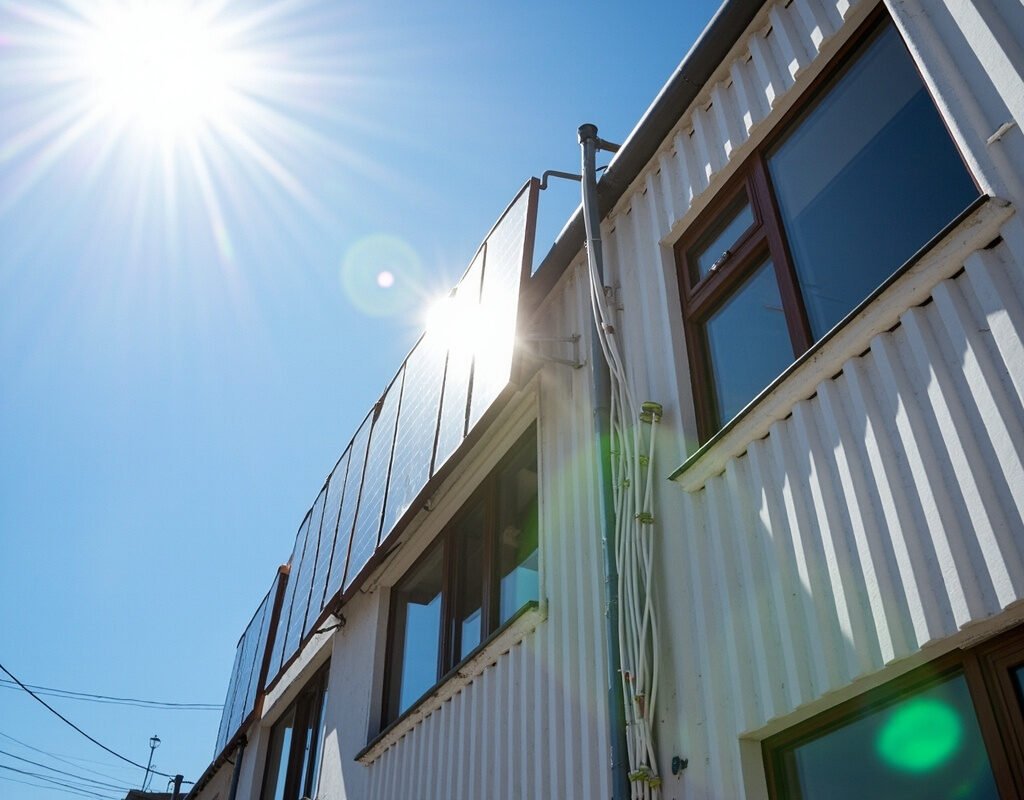
Billions of dollars worth of installed cable infrastructure silently degrades under UV radiation. Unlike dramatic failures from crushing or flooding, UV-induced degradation progresses insidiously—jackets lose strength, become brittle, crack under minor stress, exposing conductors to failure.
Consequences include:
- Premature failure in 2–5 years instead of expected 20–30 years
- Safety hazards from energized conductors exposed through cracked jackets
- Costly unscheduled replacement requiring excavation or equipment shutdown
- Code violations discovered during inspection
Iflexcable manufactures complete lines of sunlight resistant cable, weatherproof cable, and direct burial cable engineered for harsh outdoor realities.
The Science of UV Degradation
How UV Damages Polymers
Sunlight contains three UV bands affecting outdoor cable:
| Band | Wavelength | Penetration | Primary Damage Mechanism |
|---|---|---|---|
| UVB | 280–315 nm | Medium (0.1–1 mm) | Chain scission; primary degradation agent |
| UVC | 100–280 nm | Surface only (µm) | Absorbed by atmosphere; minimal ground-level |
UVB photons break covalent bonds via photo-oxidative cascade:
Polymer + hν → Polymer• (free radical initiation)
Polymer• + O₂ → Polymer-OO• (peroxy radical propagation)
→ Chain scission (strength loss), crosslinking (brittleness), chromophore formation (yellowing)
Accelerating Factors
UV synergizes with other stressors:
| Factor | Interaction | Example Scenario |
|---|---|---|
| Moisture | Hydrolysis + photodegradation combined | Tropical coastal: UV + salt spray + humidity = severe synergy |
| Ozone | Ozonolysis adds to cracking | Urban/high-altitude elevated ozone environments |
| Mechanical stress | Brittle material fails under tension | Wind movement after embrittlement |
| Chemical pollutants | Catalyze photo-reactions | Industrial SOx/NOx accelerates UV damage |
UV Resistance Standards and Testing
UL 1581 Section 1200
| Parameter | Spec |
|---|---|
| Irradiance | 0.76 W/m²/nm @ 340 nm |
| Cycle | 102min light + 18min light+spray |
| Black panel temp | 63±5°C light / 30±5°C dark |
| Duration | 720 hours (standard) or 1,000 hours (premium) |
| Pass criteria | Retain ≥70% tensile AND elongation |
Passing cables receive “Sun Res” designation.
IEC 60811-406
| Parameter | Spec |
|---|---|
| Cycle (Method B) | 8h UV @60°C / 4h condensation @50°C |
| Duration | 1,000 hours typical |
| Evaluation | Tensile strength + elongation change; visual inspection |
UV-Stabilization Technologies
Carbon Black Loading (Gold Standard)
Most effective/economical stabilizer for outdoor cable jackets:
| Parameter | Optimum Range | Deviation Effect |
|---|---|---|
| Particle size | 15–30 nm ultrafine | Larger particles scatter less effectively |
| Dispersion | Homogeneous | Agglomerates = localized vulnerability |
| Base polymer | Non-polar (PE, EPDM, EVA, EBA) | Less effective in polar polymers |
Why carbon black works so well:
- Absorbs UV (200–400 nm), converts to heat
- Traps free radicals before propagation
- Physical barrier slowing oxygen diffusion
- Opaque black physically blocks penetration
Result: Properly formulated carbon-black PE achieves 20–30 years outdoor service—the default choice for outdoor industrial cable and direct burial cable.
HALS (Hindered Amine Light Stabilizers)
For colored outdoor cable (where black is unacceptable):
| HALS Feature | Benefit |
|---|---|
| Synergy with UV absorbers | Best with benzotriazole/benzophenone absorbers |
| Effective in thin sections | Critical for thin jacket walls |
| Low color contribution | Doesn’t affect desired color |
Typical HALS formulation: LLDPE/EVA base + benzotriazole absorber (2–3%) + HALS (0.2–0.5%) + antioxidant package + inorganic pigment (TiO₂, iron oxide).
Trade-off: HALS-stabilized colors achieve 10–15 years vs carbon-black’s 20–30 years—acceptable where appearance matters.
Product Categories
Direct Burial Cable
Installed underground without conduit:
| Feature | Specification |
|---|---|
| Moisture barrier | Water-blocking tape + gel-filled interstices (flooded core) |
| UV resistance | Black HDPE jacket (2.5% carbon black) |
| Crush resistance | >2,000 N/cm² |
| Applications | Utility distribution, telecom backbone, security perimeter, irrigation |
Iflexcable DB-Series: Interlocked Al armored, flooded-core, UV-HDPE jacketed direct burial cable in power/control/communication variants.
Solar PV Wire (PV Wire / USE-2)
Photovoltaic systems require uniquely demanding outdoor cable:
| Requirement | UL 4703 Reference | Typical Value |
|---|---|---|
| UV resistance | UL 1581 Sec. 1200 | 720h xenon-arc min |
| Sunlight resistance | Required (“Sun Res”) | 25+ year rooftop survival |
| Moisture | Submersible capable | Flooded-core or dry-fill |
| Flame retardance | Optional (FT4/FT1) | Certain installations required |
Iflexcable PV-Wire Series: USE-2/PV dual-rated, XLPE insulated/jacketed, carbon-black UV protection, -40°C to +150°C, 14 AWG to 4/0 AWG.
Outdoor Industrial Ethernet/Data Cable
Extending networks outdoors requires enhanced protection:
| Feature | Indoor Cat6 vs. Outdoor Industrial Cat6 | |
|---|---|---|
| Temperature range | 0–45°C | -40~+90°C |
| Moisture | Not rated | Water-blocked gel/dry-core |
| Mechanical protection | Light duty | Optional armor |
| Rodent resistance | N/A | Repellent additives or armor |
| Conduit needed? | Often | Conduit-free (direct-burial capable) |
Iflexcable IE-Outdoor Series: Cat5e/Cat6 industrial outdoor Ethernet, UV-stable PE jacket, gel-filled water blocking, optional armor, 20+ year rating.
Aerial/Messenger-Supported Cable
For overhead spans (utility poles, building-to-building):
| Configuration | Structure | Span Capability |
|---|---|---|
| Lashed aerial | Separate messenger + lashed cable | Up to 300m+ |
| ADSS (All-Dielectric SS) | Aramid strength members + non-metallic | Near high-voltage lines |
Iflexcable AERIAL-Series: Figure-8 self-supporting, galvanized messenger, UV-XLPE jacket, up to 90m span in light-loading zones.
Installation and Lifecycle
Environmental Derating
| Environment | Service Life Multiplier (vs. baseline temperate) |
|---|---|
| Hot-arid desert (Arizona, UAE) | 0.5–0.7× |
| Tropical coastal (Singapore, Miami) | 0.6–0.8× |
| High-altitude (Colorado, Andes) | 0.7–0.9× (higher UV intensity) |