
High Temperature Cable
Introduction: Pushing the Thermal Envelope Industrial processes routinely operate at temperatures destroying standard PVC/PE cables within minutes. Foundries pour molten metal at 1,600C+; glass furnaces maintain 1,500C; jet engine exhaust exceeds 700C.…
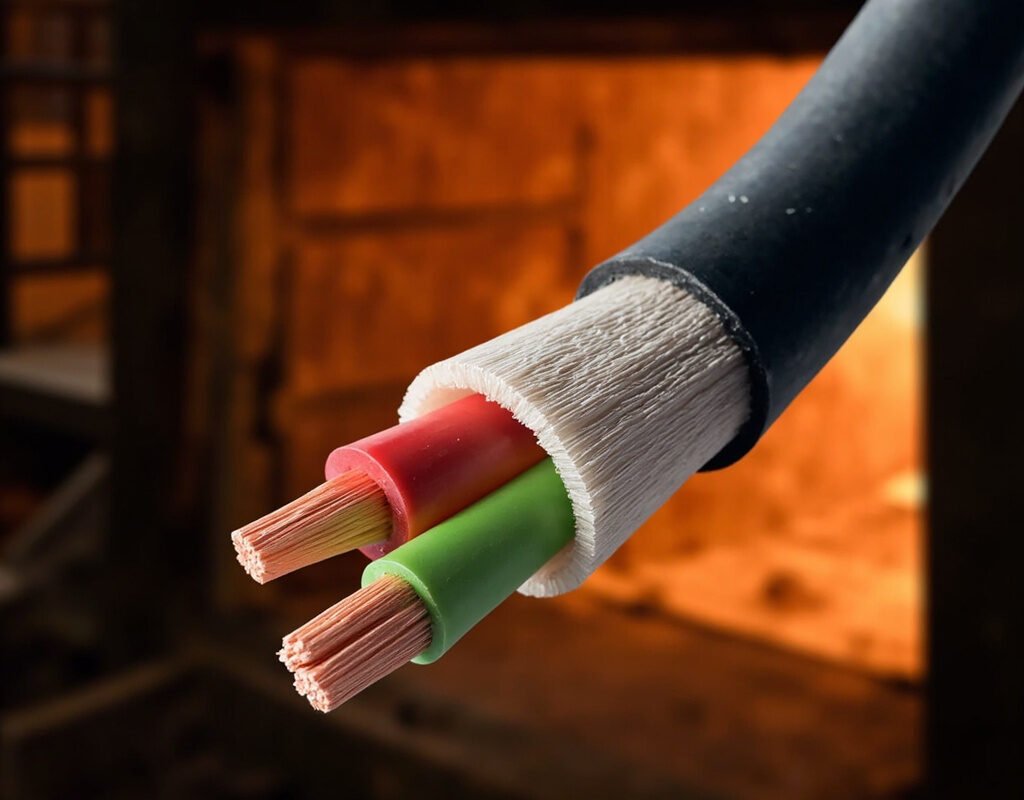
Introduction: Pushing the Thermal Envelope
Industrial processes routinely operate at temperatures destroying standard PVC/PE cables within minutes. Foundries pour molten metal at 1,600C+; glass furnaces maintain 1,500C; jet engine exhaust exceeds 700C. Each demands high temperature cable maintaining integrity where standard cables fail instantly.
Iflexcable offers high temperature cable spanning 200C (silicone) through 650C (fiberglass/silicone varnish) to 1,000C+ (MgO mineral insulated).
Temperature Rating Hierarchy
| Rating C | Primary Insulation(s) | Typical Apps | Cost Index |
|---|---|---|---|
| 125C | XLPE crosslinked | Motor winding, industrial | Low |
| 150C | Silicone rubber | Appliances, heating elements | Low-Med |
| 200C | Silicone, FEP | Ovens, engines | Medium |
| 250C | Fiberglass braid + silicone/varnish, PTFE | Steel/glass industry, kilns | Med-High |
| 350C | Fiberglass + high-temp varnish, PTFE wrap | Aluminum extrusion, foundry proximity | High |
| 450C | Mica-glass tape, PTFE/fiberglass composite | Ceramic kilns, furnace internal wiring | Very High |
| 550C | Ceramic fiber (alumina-silica) braided | Glass manufacturing, heat treatment | Premium |
| 650C+ | Ceramic fiber + special coating, MgO mineral | Extreme furnace, aerospace, metallurgy | Ultra-Premium |
Material Deep-Dive by Temperature Range
150-200C: Silicone Rubber – The Moderate-Temp Workhorse
| Property | Silicone Value |
|---|---|
| Short-term survival | Up to 300C briefly |
| Flexibility | Excellent even at -60C |
| Flame resistance | Self-extinguishing; burns to SiO2 ash |
| Water resistance | Good (hydrophobic) |
| Mechanical strength | Low (tears easily); needs protection |
Best uses: Appliance wiring, heating element leads, engine compartment, lighting fixtures, mold sensors.
200-350C: Fiberglass Braid (Impregnated)
Fiberglass insulated cable uses glass fiber braids impregnated with silicone rubber, varnish, or thermosetting resin:
| Property | Value |
|---|---|
| Impregnant options | Silicone varnish (250C max), Phenolic varnish (350C), Polyurethane (200C) |
| Abrasion resistance | Fair to good |
| Flexibility | Moderate (stiffens below -10C) |
| Moisture absorption | Hygroscopic! Must use sealed-end terminations |
| Flame resistance | Non-combustible (glass does not burn) |
CRITICAL: Fiberglass insulated cable absorbs moisture from air. When energized, absorbed moisture creates leakage paths. Always use sealed-end terminations (heat-shrink with adhesive, epoxy potting, or molded boots).
250-450C: PTFE / Teflon Family
| Fluoropolymer | Max Cont. Temp | Key Advantage | Limitation |
|---|---|---|---|
| FEP | 200C | Melt-processable easier than PTFE | Lower temp rating |
| PFA | 260C | Melt-processable higher temp | More expensive than FEP |
| ETFE | 150C | Tough mechanical; chemical resistant | Lower max temp |
PTFE advantages: Virtually non-flammable (LOI >95%); excellent chemical resistance (inert); low friction coefficient; non-aging from heat/time alone; dielectric strength 60-80 kV/mm.
Disadvantages: Cold flow under pressure (not for clamped connections); expensive (3-5x PVC); requires specialized extrusion.
450-650C: Mica-Glass Tape and Ceramic Fiber
| Material | Max Temp | Construction | Key Properties |
|---|---|---|---|
| Mica-glass muscovite | 500-650C | Similar | Higher temp but more brittle |
| Ceramic fiber alumina-silica | 650C-1000C | Braided/wrapped ceramic | Extreme temp; fragile mechanically |
Critical: All >450C insulation options are mechanically fragile. Must be supported continuously and protected from impact. NOT suitable for dynamic/flexing applications.
1000C+: Mineral Insulated (MI) Cable
| Feature | MI Cable Spec |
|---|---|
| Temp rating | Up to 1000C (SS sheath); 650C (Cu alloy sheath) |
| Mechanical protection | Excellent (metal sheath is armor itself) |
| Fire survival | Survives direct flame exposure (integrity cable) |
| Cost | Very high ($50-200+/meter) |
Applications: Fire alarm/sprinkler circuits, furnace thermocouple extensions, nuclear instrumentation, emergency power systems.
Ampacity Derating at Elevated Temperature
Formula: I_derated = I_base x SQRT[(T_max – T_ambient) / (T_max – T_base)]
AWG 12 Derating Example at Various Ambient Temps:
| Ambient | Fiberglass 250C | PTFE 200C | Silicone 150C |
|---|---|---|---|
| 100C | 87% (57A) | 82% (45A) | 63% marginal |
| 150C | 77% (50A) | Not rated! | At limit |
| 200C | 67% (44A) | At limit | FAIL |
| 250C | 57% (37A) | Exceeds | Exceeds |
Higher-rated insulation buys ampacity headroom at elevated ambient. A 250C-rated cable carries significantly more current at 150C ambient than 150C silicone of same gauge.
Application-Specific Solutions
Industrial Oven/Kiln Wiring
| Challenge | Solution |
|---|---|
| Control wiring outside hot zone | Fiberglass + varnish (350C rated) |
| Thermocouple extension | Type-specific matching calibration |
| Door seal heating | Silicone-glass flexible at hinge |
Engine Compartment / Exhaust
| Zone | Temperature | Recommended Cable |
|---|---|---|
| Turbocharger housing | 200-300C | Fiberglass braid + silicone |
| Exhaust manifold proximity | 300-500C | Mica-glass tape insulated |
| Direct exhaust contact | 500C+ | Mineral insulated (MI) only |
Aerospace Applications
| Aircraft Area | Temp | Special Requirements |
|---|---|---|
| APU exhaust area | 200-400C | Fire-resistant mandatory |
| Anti-ice system leads | 150-200C | Flexing with wing movement |
| Spacecraft external | -200 to +200C cycling | Radiation hardening |
| Re-entry leading edge | 600-1200C | MI or ceramic fiber |
Iflexcable Aero-Series: Lightweight fiberglass/PTFE composite meeting FAA FAR Part 25 flammability requirements, screened configurations for EMI-critical avionics.
Safety Considerations
| Protection Method | Effectiveness | When To Use |
|---|---|---|
| Thermal blanket wrapping | ** | Intermittent high-temp excursions |
| Air gap isolation | ** | Maintain distance from extreme heat source |
| Active cooling (air blast) | * | Critical zones near flame/molten metal |
| Heat shield (reflective metal) | ** | Radiant heat sources (furnace walls) |
| Temperature monitoring TC | * | Mission-critical installations |
Personnel protection by surface temp:
- <60C: Bare-hand OK
- 60-80C: Warning label needed
- 80-100C: Insulated gloves required
- >100C: Full thermal protection; barriers required
Conclusion
Selecting appropriate high temperature cable requires honest assessment of actual operating temperature (including worst-case transients), mechanical stress level, environmental contaminants, and lifecycle requirements. Under-specifying risks catastrophic failure; over-specifying wastes capital on unnecessarily exotic materials.
Iflexcable covers every tier from silicone (150C) through fiberglass (350C), mica-glass (550C), ceramic fiber (650C+), to mineral insulated (1000C).
Keywords used naturally: high temperature cable, high temp wire, heat resistant cable, furnace cable, ceramic insulated cable, fiberglass insulated cable, fire resistant cable