
Low Temperature / Cryogenic Cable
Introduction: When Things Get Cold, Cables Get Brittle Standard PVC-jacketed cable becomes rigid as a rod around -15C and cracks below -20C. Low temperature cable addresses maintaining flexibility and electrical integrity at…
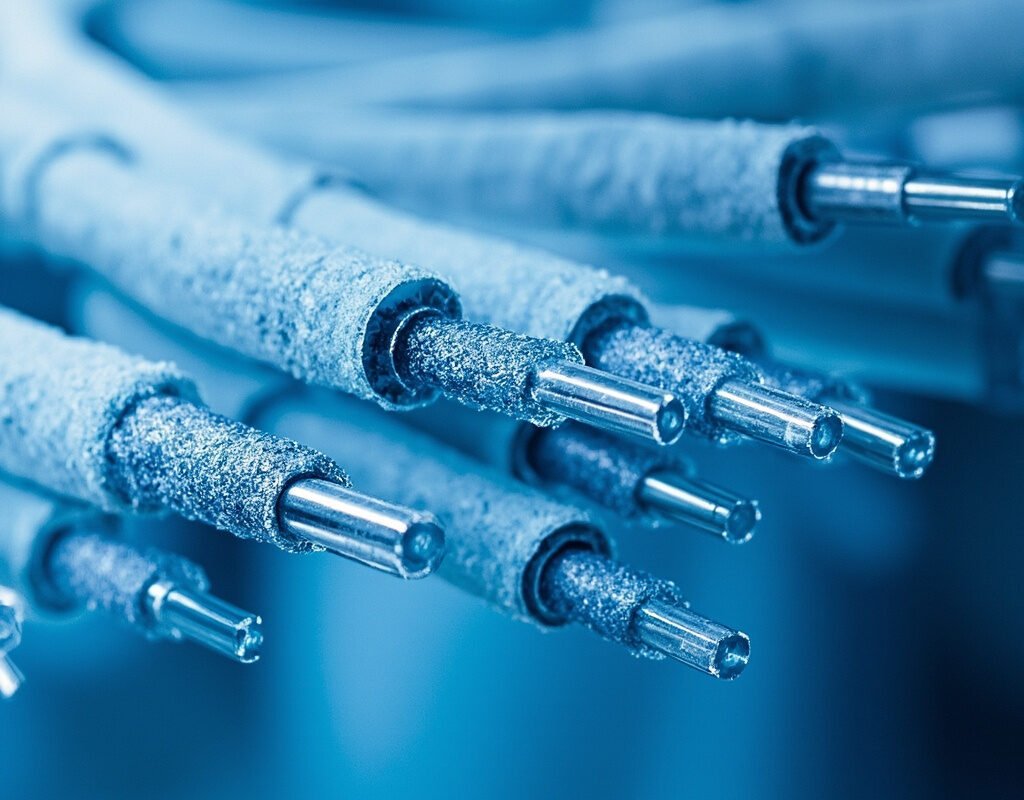
Introduction: When Things Get Cold, Cables Get Brittle
Standard PVC-jacketed cable becomes rigid as a rod around -15C and cracks below -20C. Low temperature cable addresses maintaining flexibility and electrical integrity at sub-zero temperatures where ordinary polymers lose all ductility.
Applications demanding freeze-resistant cable:
- Frozen food processing/storage: Blast freezers at -35C; spiral freezers at -50C
- LNG facilities: -162C boiling point handling
- Liquid nitrogen systems: -196C
- Cold chain logistics: -25C to -40C
- Arctic/subsea installations: -50C to -65C ambient
- Spacecraft/satellites: -200C+ shadow; thermal cycling extremes
- Pharmaceutical cold storage: ULT freezers at -80C
Glass Transition Temperature (Tg)
Every polymer has a Tg transitioning from flexible/rubbery to rigid/glassy behavior:
| Material | Tg Approx. | Safe Min Operating Temp |
|---|---|---|
| PE (HDPE) | -125C to -100C | Excellent to -70C |
| PP (polypropylene) | -20C to 0C | -20C limit |
| PUR (polyurethane) | -50C to -30C | -40C typical limit |
| TPU (thermoplastic PU) | -40C to -60C | -50C achievable |
| Silicone rubber | -123C | -60C to -80C easily |
| FEP/PTFE | -117C/-126C | -200C possible |
Key principle: Operating temp must remain 10-20 degrees above Tg to maintain adequate flexibility.
Jacket Materials Comparison
| Material | Min Flex Temp | -40C Flexibility | -60C Flexibility | Cost |
|---|---|---|---|---|
| PE (LLDPE/HDPE) | -70C to -90C | Good | Acceptable | Low-Med |
| TPE-E special grade | -50C to -70C | Fair-Good | Fair-Poor | Medium |
| PUR low-temp grade | -40C to -60C | Good | Marginal | Medium-High |
| TPU cryo-grade | -60C to -80C | Very Good | Good | High |
| Silicone rubber | -80C to -100C | Excellent | Excellent | High-Very High |
| FEP/PTFE | -200C+ | Excellent | Excellent | Very High |
Recommendation hierarchy:
- General cold (-25 to -40C): Low-temp PUR
- Deep freeze (-50 to -80C): TPU cryo-grade or silicone
- Cryogenic/LNG (-100 to -196C): FEP or PTFE
- Extreme (<-196C): Specialized materials (Kapton, composites)
Application Categories
Frozen Food Processing & Storage
| Zone | Temperature | Cable Requirement |
|---|---|---|
| Blast freezer | -35C to -50C | Low-temp TPU/PUR required |
| Spiral/tunnel freezer | -45C to -60C | Silicone or cryo-TPU recommended |
| IQF individual quick freezing | -40C to -50C | Cold flex cable oil/food resistant |
| Ice cream hardening | -35C to -40C | Washdown-capable food-grade variant |
Iflexcable FR-Series (Freezer Rated):
- FR-Light: -40C rated, PUR jacket, general cold storage
- FR-Deep: -60C rated, TPU jacket, blast/spiral freezers
- FR-Food: Food-grade FDA/EU 1935/2004 compliant
LNG Facilities (-162C)
Requirements: Operating -196C to +50C swing; ~3% thermal contraction on cooldown; no polymers with Tg above operating temp; outdoor coastal salt spray/UV exposure.
Recommended: Iflexcable LNG-Series: PTFE-insulated, SS braided cryogenic cable with arctic-grade UV-stabilized outer jacket. Validated thermal shock cycling between +50C and -196C without degradation.
Arctic/Subsea Installations
Combined cold + pressure + seawater exposure:
- Ambient -55C to -65C: Arctic-grade TPU or fluoropolymer jacket
- Seawater immersion: Submersible-rated outer jacket + flooded-core option
- Ice/scour damage: Steel wire armor layer under jacket
- UV exposure (24h Arctic summer): Carbon-black stabilized outer layer
- Installation: Cold-bend tested to -60C during installation
Pharmaceutical/Biotech Cold Chain
| Application | Temperature | Special Requirement |
|---|---|---|
| Cryogenic LN2 vapor phase | -150C to -190C | PTFE/FEP only; no organics viable |
| Dry ice transport | -78.5C short-duration | Silicone acceptable |
| LN2 dewar internal | -196C | PTFE or polyimide; special termination |
Testing Standards
| Test Method | Standard | Key Parameters |
|---|---|---|
| Impact at low temp | IEC 60811-405 | Weight drop impact on cooled sample |
| Cold flex cycling | Internal spec | Repeated bend cycles at min operating temp |
| Thermal shock | IEC 60068-2-14 | Rapid transition between high/low temp extremes |
| Brittleness temperature | ASTM D746 / ISO 812 | Lowest usable temp via impact fracture |
Conclusion
Low temperature cable selection requires understanding not just minimum temperature but also dynamic flexing requirements, installation conditions, and thermal cycling profile. A cable surviving static -60C may fail catastrophically if flexed at that same temperature.
Iflexcable covers from -40C PUR (general refrigeration) through -80C silicone/TPU (deep freeze) to -196C+ PTFE (full cryogenic), with variants for food-grade, offshore/arctic, pharmaceutical applications.
Keywords used naturally: low temperature cable, cryogenic cable, freezer cable, cold flex cable, freeze resistant cable, sub-zero cable, arctic cable, LNG cable