
Automotive Cable & EV Wire Harness
Introduction: Wiring the Connected Vehicle Modern automobiles contain 1.5–3 km of wire organized into complex automotive wire harnesses—more wiring than many small aircraft. With the accelerating shift toward electric vehicles (EVs) adding…
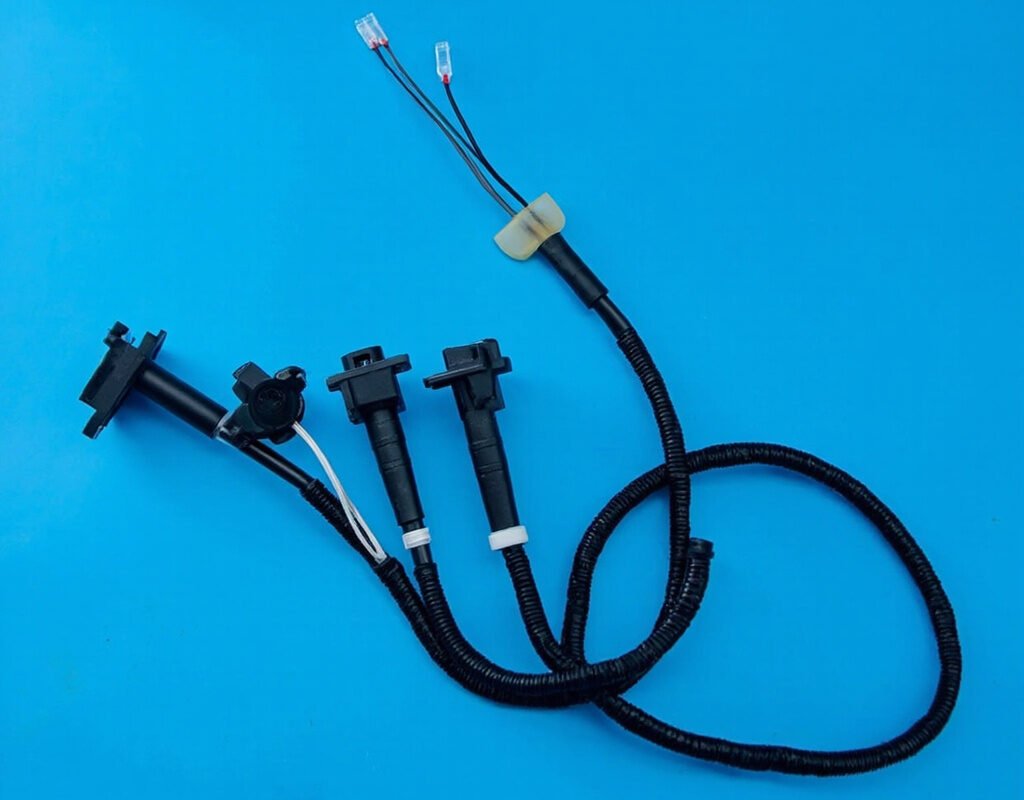
Introduction: Wiring the Connected Vehicle
Modern automobiles contain 1.5–3 km of wire organized into complex automotive wire harnesses—more wiring than many small aircraft. With the accelerating shift toward electric vehicles (EVs) adding high-voltage battery systems, ADAS (Advanced Driver Assistance Systems) demanding gigabit-speed sensor networks, and vehicle-to-everything (V2X) communications emerging as regulatory requirements, automotive cable has become one of the most technically demanding and rapidly evolving segments of the cable industry.
Key statistics driving automotive cable innovation:
- EV sales projected to reach 40% of global vehicle market by 2030 (IEA)
- Average EV contains 2x the wiring complexity of equivalent ICE vehicle (HV + LV systems coexisting)
- Autonomous vehicles may contain 5+ km of cable supporting lidar, radar, camera, compute systems
- Automotive wire harness market: $55 billion by 2028 (Grand View Research)
Iflexcable develops automotive cable and EV wire harness components meeting ISO 6722, LV 214, JASO D611, and FLRY (Flame Retardant Low Smoke) standards for traditional automotive, plus specialized EV battery cable and charging cable for electric vehicle applications.
Automotive Cable Standards Framework
Core Automotive Wire Standards
| Standard | Scope | Key Requirements | Region |
|---|---|---|---|
| SAE J1128 | Low-voltage primary wire | 60V rated; various insulation types | North America |
| JASO D611 | Japanese automotive wire | Specific to Japanese OEM requirements | Japan/Korea |
| LV 214 | Low-voltage (limited to 60V) | Thin-wall, space-saving | European vehicles |
| FLRY (ISO 19642) | Flame Retardant Low Smoke | Fire safety + low toxicity fumes | Mandatory in passenger compartments |
| ISO 14572 | Single-core automotive wire | Supplemental test methods | Global |
| USCAR-2 | Performance specification | US automaker consensus | North America |
Voltage Classification in Automotive
| Class | Voltage Range | Typical Applications | Cable Standard |
|---|---|---|---|
| EV-LV (Electric Vehicle LV) | 60–500V | EV auxiliaries, 12V accessory, some motor drives | Custom/OEM spec |
| HV (High Voltage) | 500–1000V+ | Main traction battery, drive inverter, motor, onboard charger | UL 2728, IEC 62893, OEM HV specs |
| Signal/Data | mV-level | CAN bus, LIN bus, Ethernet, LVDS, sensor signals | Various protocol-specific |
Automotive Data Communication Cables
CAN Bus Cable
Controller Area Network (CAN) remains the backbone of vehicle data communication:
| CAN Version | Speed | Cable Type | Application |
|---|---|---|---|
| CAN FD (Flexible Data-Rate) | Up to 5 Mbps | Enhanced twisted pair | Modern vehicles; ADAS |
| CAN-XL | Differential over single-wire (up to 125 kbps) | Reduced wiring comfort/convenience | Door modules, seat controls |
| CAN SIC (Single Edge CAN) | Up to 10 Mbps | Special high-speed physical layer | Future autonomous architectures |
Automotive CAN bus cable requirements (per ISO 11898-2):
- Characteristic impedance: 120 ohms (+/-15%)
- Twisted pair with defined lay length
- Shielding: Foil + optional braid (required for CAN FD high-speed)
- Temperature rating: -40C to +125C (passenger); -40C to +150C (engine bay)
- FLRY compliance: Required for interior routing (ISO 19642 Class A minimum)
Iflexcable CAN-Bus Series:
- CAN-STD: Standard 2.0A compatible, 120 ohm twisted pair, FLPY jacket
- CAN-HS: CAN FD ready, enhanced shielding, higher temperature rating
- CAN-XL: Single-wire compatible (comfort systems)
Automotive Ethernet (100BASE-T1S / 1000BASE-T1S)
Automotive Ethernet (IEEE 802.3bw for 100Mbps, 802.3bp for 1Gbps) uses Single-Pair Ethernet (SPE):
| Parameter | 100BASE-T1S | 1000BASE-T1S |
|---|---|---|
| Conductors | 1 twisted pair (2 wires!) | 1 twisted pair |
| Connector | MATEnz (IEEE 802.3cg) | MATEnz or proprietary |
| Cable length | Up to 15m (point-to-point) | Up to 15m (may extend) |
| Shielding | F/UTP or S/FTP | S/FTP recommended for 1G |
| Priority | Real-time traffic class | Time-sensitive networking (TSN) |
Impact: Automotive Ethernet cable replaces heavy 4-pair/8-wire bundles with 2 wires delivering equivalent bandwidth—a revolutionary reduction in automotive wire harness mass and volume for ADAS and infotainment applications.
Iflexcable AUTO-ETH Series: MATEnz-compliant SPE cable for 100/1000 Mbps automotive Ethernet, FLPY jacketed (flame-retardant low smoke), temperature rated to +125C, available in shielded (for ADAS/safety) and unshielded (for infotainment) variants.
LVDS (Low-Voltage Differential Signaling)
Legacy but still prevalent for camera-to-display links in vehicles:
| Parameter | LVDS Cable Requirement |
|---|---|
| Impedance | 100 ohm differential (±15%) |
| Skew | Critical! Must match lane-to-lane within spec |
| Shielding | Foil + braid recommended (display interfaces sensitive) |
| FLPY | Mandatory for cabin routing |
EV-Specific Cable Systems
High-Voltage (HV) Battery Cable
EV battery cable connects the traction battery pack to the rest of the drivetrain:
| Parameter | Typical Value |
|---|---|
| Max voltage | 1000V DC (transient) |
| Current capacity | 200–500A (peak); 100–300A continuous |
| Operating environment | Under-vehicle; road splash; vibration; crash safety critical |
| Safety classification | HVIL-Orange (high-voltage identification) marking required |
| Standard reference | UL 2728, IEC 62893-1 (EV/HV safety), SAE J3018 |
EV battery cable construction features (beyond standard HV cable):
- Double-insulated or triple-insulated for redundancy
- Orange outer jacket (mandatory HV identification per international standard)
- Shielded variant (reduces EMI from inverter switching reaching other vehicle systems)
- Crash-performance validated (must not become projectile in collision)
- Vibration-resistant (road-induced vibration spectrum 5–500 Hz)
Iflexcable HV-BATT Series: Orange-jacketed EV battery cable meeting UL 2728 and IEC 62893, available 35–95 mm2, with double-insulation option, shielded variant for EMI-sensitive layouts.
EV Charging Cable (Vehicle Side)
On-board charger (OBC) input cable and DC charging port inlet cable:
| Charging Level | Onboard Cable Spec | Inlet Cable Spec |
|---|---|---|
| DC CCS1 | Up to 450V DC, 200A, 50 mm2 | CCS1 Combo connector |
| DC CCS2 | Up to 1000V DC, 350A, 95 mm2 | CCS2 Combo connector |
| CHAdeMO | Up to 1000V DC, 400A, 95 mm2 | CHAdeMO connector |
| Tesla NACS | Up to 1000V DC, 650A, 130 mm2 | Tesla connector |
| GB/T (China) | Per GB/T 20234/20238 | China-standard connector |
Thermal management note: Liquid-cooled charging cables increasingly standard for >200A DC charging, circulating dielectric coolant through integrated channels within the EV charging cable assembly to remove up to 95% of resistive heating.
Iflexcable EV-CHG Series:
- AC Charge: J1772-compatible Level 1/2 cable (handle + pilot + control)
- DC CCS: CCS1/CCS2 high-voltage charge cables (liquid-cooled option available)
- CHAdeMO: Compatible CHAdeMO charge cable assemblies
- Inlet-to-OBC: Internal inlet cable set for OBC integration
Wire Harness Manufacturing for Automotive
Key Quality Systems
| Certification | Scope | Authority |
|---|---|---|
| APQP PPF | Production Part Approval Process | AIAG (Automotive Industry Action Group) |
| VDA 6.3 / VDA 6.5 | Process audit | German Automotive Association (VDA) |
| UL/CSA recognition | Product listing safety | Underwriters Laboratories |
Iflexcable automotive cable production operates under IATF 16949 certified quality management system, ensuring traceability, process control, and continuous improvement aligned with global automotive OEM expectations.
Future Trends in Automotive Cabling
| Trend | Direction | Impact on Cable |
|---|---|---|
| Zone architecture (zonal E/E arch) | Separated LV/HV domains | Clearer segregation of cable types |
| Wireless replaces some wiring | Bluetooth, UWB for sensors | Reduces but doesn’t eliminate cable needs |
| Optical fiber in vehicles | Infotainment, isolation barriers | Automotive optical fiber cable emerging |
| 48V mild-hybrid systems | Higher auxiliary voltage | 48V-rated LV cable replacing 12V systems |
| Solid-state battery (SSB) | Different form factor/cell-level voltages | New SSB cable specifications likely needed |
Conclusion
Automotive cable sits at the intersection of rigorous safety regulation, extreme environmental demands, and relentless cost/weight reduction pressure. Whether you’re specifying CAN bus cable for a body control module, LVDS cable for camera links, automotive Ethernet for ADAS data backbones, or EV battery/charging cable for electric vehicles—proper specification against applicable standards (ISO 6722, LV 214, UL 2728, SAE J3018) is non-negotiable for safety, reliability, and regulatory compliance.
Iflexcable‘s automotive cable portfolio covers the full spectrum from FLRY-compliant LV wire through HV Orange battery cable to automotive Ethernet SPE and EV charging assemblies—all produced under IATF 16949 certification for automotive quality assurance.
Keywords used naturally: automotive cable, automotive wire harness, EV cable, CAN bus cable, automotive ethernet cable, battery cable, EV charging cable, FLYR cable, LVDS cable