
High Speed Motion Cable
Introduction: When Speed Kills Cables Modern delta robots achieve accelerations exceeding 50G while sorting 150+ items/min. High-speed pick-and-place machines cycle 200+/min. These dynamics place extraordinary demands on motion cable: inertial loading, torsional…
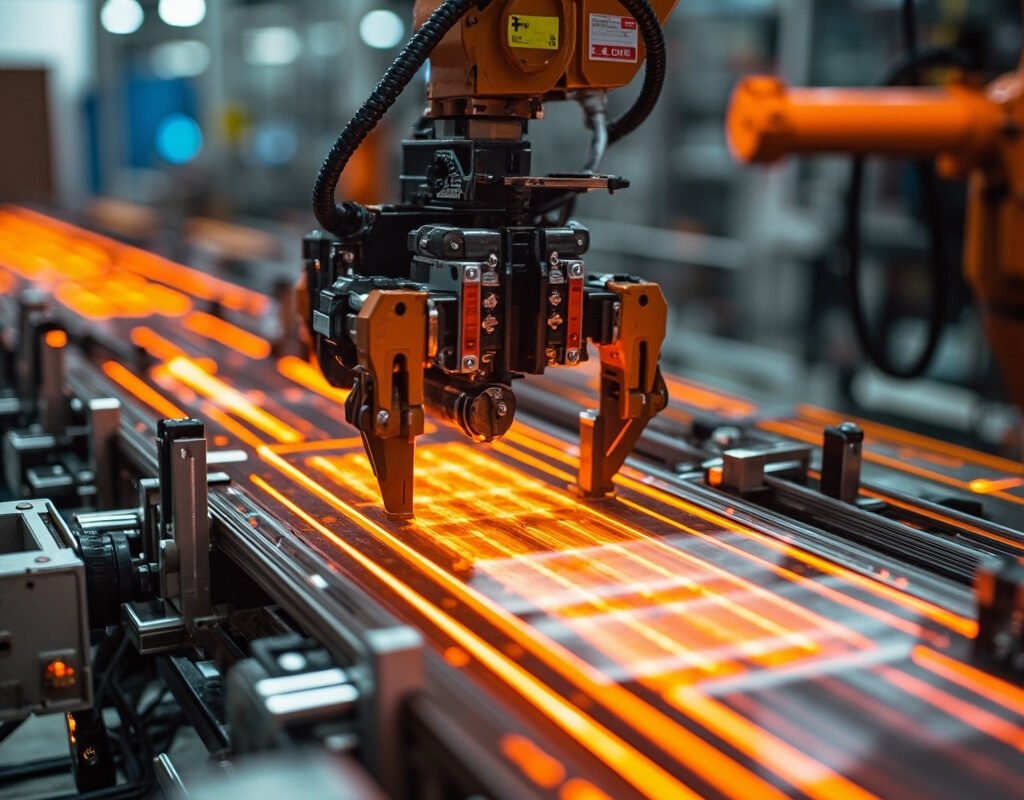
Introduction: When Speed Kills Cables
Modern delta robots achieve accelerations exceeding 50G while sorting 150+ items/min. High-speed pick-and-place machines cycle 200+/min. These dynamics place extraordinary demands on motion cable: inertial loading, torsional shear stress, millions of fatigue cycles/year, resonance excitation.
Iflexcable develops acceleration-rated cable validated against G-force profiles from actual robotic kinematics.
Understanding Acceleration Forces
Linear Inertial Force
F_inertial = m_cable x a_acceleration
Example: 50g/m cable x 2m length x 50G (490 m/s2) = 49N peak force oscillating 200+/min creates fatigue loading rather than static load.
Torsional Acceleration
Rotational motion adds shear stress. For delta robot cable rotating 1m from joint axis at 10,000 deg/s2 (175 rad/s2): Shear can exceed 5MPa at cable perimeter – enough to delaminate poor constructions.
Combined real-world loading: simultaneous linear X/Y/Z acceleration + rotation about multiple axes + bending along curved paths + vibration from motors/bearings. Superposition can peak at 3-5x individual component magnitudes.
Design Principles for High-Speed Cable
Mass Reduction (Every Gram Counts!)
Halving cable mass directly halves inertial forces for given acceleration:
| Strategy | Mass Reduction | Complexity | Trade-off |
|---|---|---|---|
| Smaller gauge if current allows | Proportional to area2 reduction | May need redesign circuit | May need higher voltage |
| Thinner walls (better dielectric) | 10-20% mass saving | Needs better material | Higher unit cost |
| Remove unnecessary shielding | 15-30% savings | EMI may increase | Use differential signaling instead |
| Replace Cu with Al alternatives | 50% lighter | Different conductivity/termination | Larger gauge for same current |
Iflexcable lightweight philosophy: For pick-and-place cable and delta robot cable, optimize entire signal chain to minimize moving mass.
Fatigue Resistance Features
| Feature | Function | Why Critical at High Speed |
|---|---|---|
| Short-pitch stranding | Distributes stress across more wires | Each strand carries less load |
| Sliding inner layers | Allows controlled relative motion | Prevents stress concentration at fixed points |
| Central strength member | Absorbs tensile loads | Protects from inertial tension |
| Extended flex zone at terminations | Reduces anchor-point concentration | Most failures occur near termination |
Application Profiles
Delta Robot (Spider Robot) – Ultimate High-Speed Challenge
| Parameter | Typical Delta Robot Spec |
|---|---|
| Acceleration | 10G-150G peak |
| Travel distance | 300-1200 mm workspace |
| Payload | 1-20 kg including end-effector cabling |
| Cable routing | Through hollow arm tubes; complex 3D path |
| Constraints | Minimal mass; extreme flex; difficult replacement |
Failure consequences: Production stoppage (high-value line); potential projectile hazard (dropped item at speed); difficult replacement (threaded through confined arm interior)
Iflexcable DELTA-Series delta robot cable:
- Ultra-lightweight construction (<30g/m for signal bundles)
- Class 7 extra-fine stranding (max fatigue resistance)
- PTFE or FEP insulation (thin-walled, high-dielectric, chemically inert)
- Integrated hybrid design (power + encoder + I/O in optimized geometry)
- Validated at 100G acceleration with >20 million cycle fatigue life
High-Speed Pick-and-Place Systems
Cartesian/SCARA pick-and-place machines:
| Parameter | Range |
|---|---|
| Axis speed | 1-5 m/s (X/Y); 5-15 m/s (Z) |
| Axis acceleration | 20-100 m/s2 (2-10G) |
| Cable management | Drag chain (e-chain) on fastest axes |
| Yearly cycles | 10-50 million |
At 3 m/s travel in e-chain: high speed drag chain cable experiences both bending fatigue AND significant longitudinal acceleration/deceleration forces on every stroke reversal.
Iflexcable HSP-Series (High Speed Pick): E-chain compatible acceleration-optimized:
- Low-profile oval geometry (reduces air drag)
- Internal damping elements (suppresses resonance vibration)
- Symmetrical lay-up (balanced bidirectional response)
- PUR jacket (abrasion-resistant for chain sidewall contact)
- Tested to 10 m/s chain speed with 15 million cycle validation
Semiconductor / Electronics Assembly
SMD component placement machines:
| Requirement | Specifics |
|---|---|
| Cycle time | 0.05-0.3 sec (ultra-high-speed) |
| Clean room compatible? | Often yes ISO Class 5-7 |
| EMI sensitivity | Extremely sensitive (nearby electronics) |
Iflexcable SEMI-Series: Clean-room compatible high speed cable
- Outgassing-certified materials (ISO 14644 compliant)
- Non-shedding jacket surface
- Individual pair shielding (EMC containment)
- Miniaturized OD (space constraint in placement head)
Testing Protocol
| Stage | Condition | Duration/Cycles | Pass Criteria |
|---|---|---|---|
| Dynamic cycling (simulated delta) | 10-50G peak variable freq | 5-20 million cycles | Continuity maintained |
| Combined accel+flex | 20G accel + 10xOD bend radius | 2 million cycles | No conductor breakage |
| Resonance sweep | Frequency sweep 10-2000 Hz | Full spectrum | No amplification >3x input |
Before release: 6-month beta in actual production machine; >99.5% uptime requirement; joint customer/Iflexcable approval.
Conclusion
Physics of high speed motion are unforgiving. Every gram compounds demand on motion infrastructure. Using conventional “flexible” cable in a 50G environment is a reliability gamble resulting in premature failure and costly downtime.
Iflexcable acceleration-rated family: DELTA-Series (parallel robots), HSP-Series (pick-and-place), SEMI-Series (electronics assembly). Contact specialists with your kinematic parameters.
Keywords used naturally: high speed motion cable, high velocity cable, pick and place cable, delta robot cable, acceleration rated cable, high speed robot cable