
Medical Grade Cable
Introduction: Life-Critical Reliability in Medical Cabling Medical cables directly interface with human patients in settings where reliability affects patient outcomes. Whether transmitting ECG signals, delivering electrosurgical energy, or conveying ultrasound images, medical…
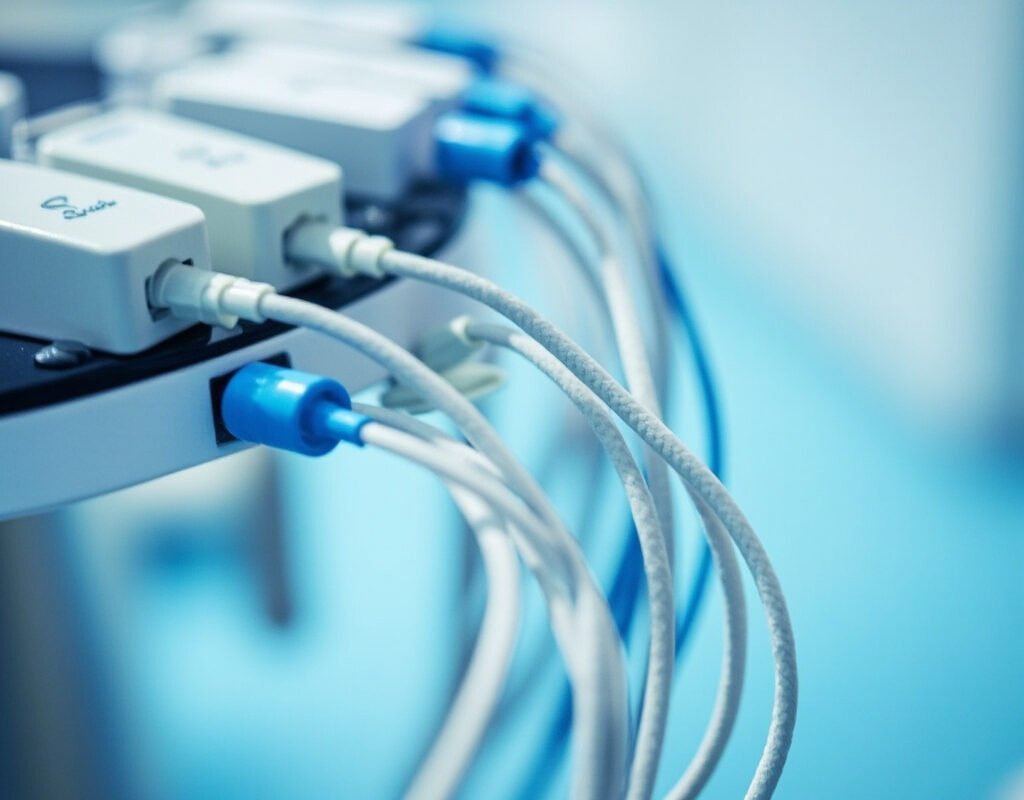
Introduction: Life-Critical Reliability in Medical Cabling
Medical cables directly interface with human patients in settings where reliability affects patient outcomes. Whether transmitting ECG signals, delivering electrosurgical energy, or conveying ultrasound images, medical grade cables must meet the most exacting standards of safety and biocompatibility known in any industry.
The global medical device market exceeds $500 billion annually, with cables representing ~3–5% of device cost—but disproportionately influencing regulatory approval success and patient safety.
Iflexcable develops medical grade cables meeting IEC 60601, ISO 10993, FDA QSR 21 CFR 820, and MDR/IVDR requirements.
Regulatory Landscape
IEC 60601 — Means of Patient Protection (MOPP)
IEC 60601-1 defines two independent protection means against electric shock:
| MOPP Type | Definition | Cable Requirement |
|---|---|---|
| MOPP (Protective Earth) | Earth conductor connection | Continuous earth continuity; impedance limits apply |
Patient Leakage Current Limits
Extraordinarily tight limits demand exceptional insulation resistance (>10¹² Ω·m) and controlled geometry:
| Applied Part Type | Normal Condition | Single Fault Condition |
|---|---|---|
| Type CF (Cardiac Floating) | 10 µA AC | 50 µA AC |
Cardiac applications (Type CF) represent the most challenging patient cable design category, requiring specialized low-leakage PTFE/FEP/silicone insulation with guard/shield configurations diverting leakage away from patients.
ISO 10993 — Biocompatibility Testing
When biocompatible cable contacts patients, it must pass ISO 10993 testing:
| Test | What It Measures | Required For |
|---|---|---|
| Part 10: Irritation/Sensitization | Skin reaction potential | External/communicating devices |
| Part 11: Systemic Toxicity | Body-wide toxic effects | Blood path contact |
| Part 18: Irradiation Effects | Gamma/e-beam sterilization effects | Radiation-sterilized devices |
| Part 7: EtO Residuals | Ethylene oxide residue levels | EtO-sterilized devices |
Iflexcable provides full ISO 10993 test report packages from accredited labs.
Regional Differences
| Region | Primary Standard | Additional Requirements |
|---|---|---|
| European Union | IEC 60601 series | MDR (2017/745); IVDR (2017/746) |
| China (NMPA) | GB 9706.1 | NMPA registration; YY 0505 EMC |
| Japan (PMDA) | JIS T 0601-1 | PMDA Shonin approval |
| Canada | CAN/CSA-C22.2 601.1 | MDL license; CMDR requirements |
Sterilization Compatibility
| Method | Conditions | Compatible Materials | Common Failures |
|---|---|---|---|
| Ethylene Oxide | 37–63°C, 40–80% RH | Most polymers (widest compat.) | Requires aeration outgassing |
| Gamma Irradiation | 25 kGy typical | PE, PTFE, FEP, stabilized PU | PVC yellows; some TPEs degrade |
| H₂O₂ Plasma | 45–58°C | Silicone, PTFE, FEP, stabilized polymers | Generally gentle on most |
| Glutaraldehyde | 20–25°C, 10–12h | Most stable polymers | Swelling possible in plastics |
Medical Cable Categories by Application
Diagnostic Imaging Cables
| Modality | Signal Challenge | Solution |
|---|---|---|
| MRI | Weak RF signals; strong magnetic field | Fully non-magnetic materials only; MRI-safe designs |
| CT Scanner | Thousands of detector channels | Custom multi-conductor flat ribbon; fiber optic alternatives |
| X-Ray (Digital) | HV tube control + detector data | Separate HV reinforced-insul. + shielded data cable |
| PET/SPECT | Nanosecond timing precision | Controlled-impedance matched-length sets |
Iflexcable Diagnostic Series: MRI-safe cables, ultra-low-capacitance ultrasound probe cables, CT slip-ring optimized assemblies.
Electrosurgical (ESU) Cables
ESU generators deliver RF energy (300 kHz–3 MHz) up to 400W:
| ESU Cable Requirement | Specification | Safety Rationale |
|---|---|---|
| Current capacity | 5–10 A continuous | Full power without overheating |
| Shield effectiveness | >95% coverage | Minimize radiated EMI |
| Handpiece connector | Ruggedized quick-disconnect | OR efficiency; prevent accidental disconnect |
Critical: ESU patient cables (return electrodes) carry full return current. Poor connections cause REM alarms, burns, or ground-pad fires—all documented adverse events.
Iflexcable ESU-Series: Fully IEC 60601-2-2 compliant, tested 6,000V AC reinforced insulation, REM-compatible options.
Patient Monitoring Cables
| Type | Signal | Complexity | Key Requirement |
|---|---|---|---|
| SpO₂ | Red/near-IR optical | Fiber or 2-conductor + sensor head | Optical clarity; flexibility |
| NIBP | Pneumatic air tube signal | Single/dual lumen air hose | Leak-free; kink-resistant; comfort |
| Temperature | Thermistor/thermocouple mV | 1–2 conductor | ±0.1°C accuracy; response time |
Design challenge: Balancing signal quality (rigid, short, heavily shielded) vs patient comfort (lightweight, flexible, long). Modern designs use active conditioning at patient end.
Surgical Instrument Cables (Robotic Systems)
Robotic surgical systems (da Vinci®, Hugo™, Versius® etc.) place unique demands:
| Requirement | Typical Spec | Why It Matters |
|---|---|---|
| Extreme flex | >10M bend cycles (multi-axis torsion) | Constant wrist articulation |
| Sterilization | Autoclave 134°C × 100+ cycles | Between-procedure reprocessing |
| Bioburden control | Pyrogen-free, non-shedding | Infection prevention in sterile field |
| Latency | <5 ms propagation | Real-time surgeon feedback |
Iflexcable Surgical Robotics Series: PTFE-insulated, stainless-overbraided, miniature-diameter surgical cables validated for >200 autoclave cycles with zero drift.
Material Selection Guide
Insulation Comparison
| Material | Biocompat. (ISO 10993) | Dielectric Strength | Flexibility | Sterilizability | Cost |
|---|---|---|---|---|---|
| FEP | Excellent | 50–70 kV/mm | Good | ★★★★★ | High |
| Silicone | Excellent | 20–25 kV/mm | Excellent | ★★★☆☆ | Medium |
| PU (medical) | Good | 15–25 kV/mm | Excellent | ★★★☆☆ | Med-Low |
| PVC (medical) | Acceptable | 15–20 kV/mm | Good | ★★☆☆☆ | Lowest |
| TPE-E (medical) | Good | 20–30 kV/mm | Very Good | ★★★☆☆ | Med-Low |
| PEEK | Excellent | 20–30 kV/mm | Fair | ★★★★★ | Premium |
Quality Management
Iflexcable maintains ISO 13485:2016 certification for medical device cable production lines ensuring full QSR and MDR compliance readiness—including design controls (DMR/FMEA), clean room assembly (ISO Class 7 minimum), process validation (IQ/OQ/PQ), and complete traceability (UDI capable).
Conclusion
Every medical grade cable carries implicit responsibility for patient safety. Whether developing next-gen surgical robots or specifying diagnostic imaging components, Iflexcable provides IEC 60601 compliant, ISO 10993 biocompatible, regulatory-ready solutions backed by ISO 13485-certified quality systems.
Keywords used naturally: medical grade cable, IEC 60601 cable, biocompatible cable, patient contact cable, medical device cable, hospital equipment cable, surgical cable, diagnostic imaging cable