
PUR Sheath High Flex Cable
Introduction: Why PUR Became the King of Industrial Cable Jackets Walk through virtually any modern manufacturing facility—from CNC machine shops to automated warehouses—and you’ll find the same story told thousands of times:…
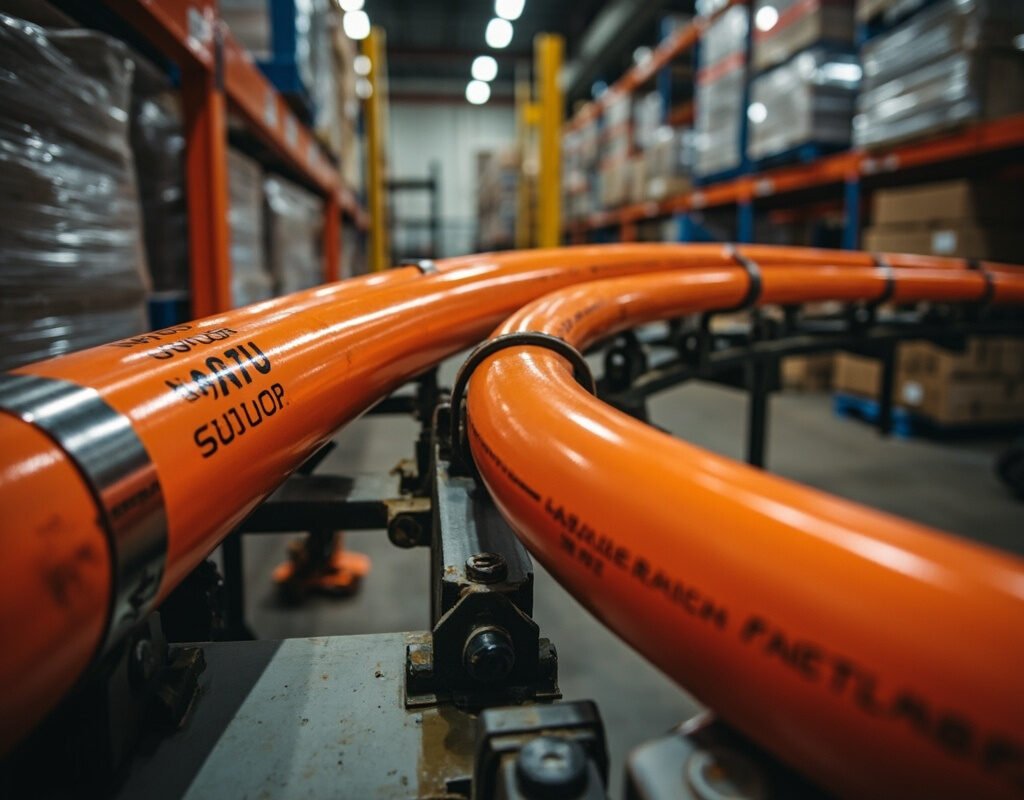
Introduction: Why PUR Became the King of Industrial Cable Jackets
Walk through virtually any modern manufacturing facility—from CNC machine shops to automated warehouses—and you’ll find the same story told thousands of times: PUR sheath high flex cable has replaced PVC as the default choice for anything that moves, bends, rubs against surfaces, or encounters oils, coolants, or chemicals.
The numbers tell the story clearly:
| Metric | Standard PVC | PUR (Polyurethane) | Improvement Factor |
|---|---|---|---|
| Flex life (cycles to failure) | 0.5–2 million | 10–30 million | 10–15× better |
| Oil resistance | Swells/degrades | Minimal effect | Qualitative leap |
| Cold temperature flexibility | Brittle at -15°C | Flexible to -40°C | 25°C improvement |
| Cut resistance | Easily severed | Highly resistant | 3–5× better |
| Service life in typical industrial use | 6–18 months | 3–7 years | 4–6× longer |
This comprehensive handbook explains WHY polyurethane sheath cable outperforms alternatives so decisively, HOW different PUR grades perform across key parameters, and WHAT engineers need to know to specify the optimal PUR jacketed cable for any given application.
Chapter 1: PUR Material Science Fundamentals
Molecular Architecture
Polyurethane (PUR) belongs to the thermoplastic elastomer (TPE) family—a unique class of materials that combine the processing advantages of thermoplastics (melt-processable, recyclable) with the elastic properties of vulcanized rubbers:
PUR molecular structure:

[HARD SEGMENT] — [SOFT SEGMENT] — [HARD SEGMENT] — [SOFT SEGMENT] — ...

Hard Segment Composition:
  Diisocyanate (MDI or TDI) + Chain Extender (BDO or similar)
  → Forms rigid crystalline domains
  → Provides: STRENGTH, HARDNESS, TEAR RESISTANCE, THERMAL STABILITY

Soft Segment Composition:
  Long-chain Polyol (polyether OR polyester type)
  → Forms amorphous, mobile regions
  → Provides: ELASTICITY, FLEXIBILITY, LOW-TEMP PERFORMANCE

Microphase Separation (the secret to PUR's properties):
  Hard segments cluster together into "physical crosslinks"
  Soft segments form continuous flexible matrix
  Result: Material that STRETCHES like rubber but PROCESSES like plastic
The Critical Choice: Polyether vs. Polyester Polyol
This single formulation decision defines the PUR sheath cable‘s performance profile:
| Property | Polyether-Based PUR | Polyester-Based PUR Winner | |
|---|---|---|---|
| Low-temperature flexibility | ✅ Excellent (-50°C) | Good (-30°C) | Polyether |
| Abrasion resistance | Very Good (25–35 mm³) | Excellent (15–25 mm³) | Polyester |
| Oil/fuel resistance | Excellent | Excellent | Tie |
| Ozone/UV resistance | Good | Good | Tie |
| Tensile strength | 28–38 MPa | 35–50 MPa | Polyester |
| Cost | Higher (more expensive polyols) | Lower | Polyester |
| Microbial resistance | Good | Poor (microbes eat ester linkages) | Polyether |
| Best for… | Wet/outdoor/submersible | Dry/indoor/heavy-abrasion | Context-dependent |
For most industrial cable applications involving potential water or humidity exposure, POLYETHER-BASED PUR is strongly recommended. Polyester-based PUR should be reserved for dry, high-abrasion applications where cost optimization is important.
Chapter 2: Mechanical Performance in Detail
Abrasion Testing and Interpretation
DIN 53516 (now largely superseded by ISO 4649) is the standard abrasion test for heavy duty flex cable jacket materials:
DIN 53516 Test Protocol:
1. Taber-type abrasion wheel (CS-10 wheel, 10N load)
2. Sample rotated against wheel for defined number of cycles
3. Material volume loss measured (mm³) — LOWER is BETTER

Reference values (mm³ material lost):
├── 200+: Very poor (would fail quickly in any abrasive environment)
├── 120–180: Standard PVC (adequate for fixed installation only)
├── 80–120: Flexible PVC (light-duty moving applications)
├── 50–80: TPE / nitrile rubber (moderate-duty flex)
├── 30–50: Standard PUR (good industrial performance)
├── 15–30: Premium / reinforced PUR (excellent)
├── <15: Ultra-premium / ceramic-reinforced (exceptional; specialized)
Real-world translation: A cable with 25mm³ abrasion loss will withstand approximately 3–5× the floor contact time of a 125mm³ PVC cable before wearing through to conductors.
Tear Strength and Cut Resistance
| Material | Tear Strength (N/mm) | Cut Resistance Index | Practical Significance |
|---|---|---|---|
| Flexible PVC | 20–35 | Low-Moderate | Slightly better but still vulnerable |
| EPDM rubber | 25–40 | Moderate | Good tear propagation resistance |
| NBR (nitrile) | 30–50 | Good | Oil-resistant option with decent cut resistance |
| PUR (standard) | 50–80 | Very Good | Resists most cutting hazards in normal use |
| PUR (premium/aromatic) | 80–120+ | Excellent | Approaching “cut-proof” for industrial hazards |
| PUR + aramid reinforcement | 150+ | Outstanding | Used in extreme-abrasion environments |
Tensile Properties and Elastic Recovery
PUR jacketed cable demonstrates superior elastic recovery compared to PVC:
Elastic recovery test results (representative data):
Material stretched to 100% strain, then released:
├── PVC: Permanent set = 15–25% (stays stretched)
├── TPE-S: Permanent set = 8–15%
├── PUR: Permanent set = 2–8% (returns nearly to original)
│
Implication for cable: After being pulled around a corner or pulley,
PUR-jacketed cable returns closer to its original dimensions,
reducing stress on internal components and maintaining consistent
electrical characteristics.
Chapter 3: Environmental and Chemical Performance
Oil and Chemical Compatibility (Expanded)
Complete compatibility matrix for oil resistant PUR cable:
| Chemical | Exposure Condition | Volume Change | Hardness Change | Tensile Retention | Verdict |
|---|---|---|---|---|---|
| ISO VG 68 gear oil | 70°C, 168h | <8% | <8 Shore A | >80% | ✅✅ Excellent |
| SAE 10W-30 motor oil | 23°C, 30 days | <3% | Negligible | >90% | ✅✅ Excellent |
| Diesel fuel | 23°C, 30 days | 10–20% | -5 to -10 Shore A | 70–80% | ⚠️ Acceptable (short-term) |
| Gasoline (unleaded) | 23°C, 7 days | 15–30% | -10 to -15 Shore A | 60–75% | ⚠️ Marginal (avoid continuous) |
| Synthetic cutting fluid (5%) | 50°C, 168h | <3% | <3 Shore A | >90% | ✅✅ Excellent |
| Soluble oil emulsion (10%) | 50°C, 168h | <5% | <5 Shore A | >85% | ✅✅ Excellent |
| Isopropyl alcohol | 23°C, 7 days | 5–10% | -3 to -8 Shore A | 80–90% | ✅ Good |
| Acetone | 23°C, 1 hour | Swelling/Dissolution | Softening | Rapid degradation | ❌ Avoid |
| Toluene | 23°C, 24 hours | 40–60% swell | Significant softening | <50% | ❌ Avoid |
| 10% NaOH (caustic soda) | 23°C, 7 days | <3% | Negligible | >88% | ✅ Good |
| 10% H₂SO₄ (sulfuric acid) | 23°C, 7 days | <5% | <5 Shore A | >85% | ✅ Good |
| Seawater | 23°C, 30 days | 0.5–1.5% | Negligible | >90% | ✅✅ Excellent (polyether grade) |
Temperature Performance Across Grades
| Grade Code | Continuous Temp | Short-Term Peak | Cold Flex | Key Characteristics |
|---|---|---|---|---|
| PUR-LT (Low Temperature) | -50°C to +80°C | +105°C | -50°C | Arctic/freezer applications |
| PUR-HT (High Temperature) | -30°C to +90°C | +125°C (48h max) | -30°C | Hot environments (near motors, heaters) |
| PUR-WR (Welding Resistant) | -25°C to +85°C | +110°C | -25℃ | Weld spatter resistant (special formulation) |
| PUR-UV (Outdoor) | -35°C to +80°C | +105°C | -35°C | UV-stabilized; direct sunlight suitable |
| PREMIUM (All-around) | -50°C to +90°C | +125°C | -50°C | Best available properties; highest cost |
Chapter 4: Flex Life Engineering
Factors Determining Flex Life
The service life of PUR sheath high flex cable in dynamic applications depends on multiple interacting factors:
Flex life (N_f) is influenced by:

N_f ∝ (1/σ_max)^b × f(material) × g(geometry) × h(environment)

Where:
  σ_max = maximum bending stress each cycle
  b = material fatigue exponent (PUR: typically 3–5)
  f(material) = inherent fatigue resistance of PUR grade
  g(geometry) = bend radius, cable diameter, conductor stranding
  h(environment) = temperature, chemical exposure, speed

PRACTICAL DESIGN RULES FOR MAXIMUM FLEX LIFE:

Rule 1: Bend Radius
  Minimum dynamic bend radius = 10× to 12× cable OD
  Each reduction of 1× OD reduces flex life by ~30-50%

Rule 2: Travel Speed
  Maximum recommended speed = 3–5 m/s for PUR cables
  Higher speeds generate more heat at bending points
  Heat accelerates polymer fatigue

Rule 3: Acceleration
  Limit acceleration to <25 m/s² at the cable
  High acceleration = high inertial forces on cable mass

Rule 4: Cycle Frequency
  More cycles per unit time = less cooling time between cycles
  Accumulated fatigue damage accelerates

Rule 5: Temperature
  Every 10°C above 20°C approximately HALVES flex life
  (Arrhenius relationship for polymer fatigue)

Rule 6: Combined Stresses
  Torsion + bending simultaneously is MUCH worse than either alone
  Reduction factor: 3–5× when both stresses present
Calculated Service Life Examples
| Application | Cable OD | Bend Radius | Cycles/Day | Speed | Est. Service Life |
|---|---|---|---|---|---|
| CNC drag chain (short travel) | 12mm | 120mm (10×) | 20,000 | 3 m/s | 3–5 years |
| Large gantry robot | 22mm | 240mm (~11×) | 10,000 | 2 m/s | 5–7 years |
| Crane festoon system | 18mm | 180mm (10×) | 5,000 | 0.5 m/s | 8–12 years |
| High-speed sorting system | 6mm | 54mm (9×) | 200,000 | 5 m/s | 1–2 years |
| Articulated robot wrist | 10mm | Torsion ±180° | 30,000 | Variable | 2–4 years |
Chapter 5: Standards and Certifications
Key Applicable Standards
| Standard | Scope | Relevance to PUR Sheath Cable |
|---|---|---|
| IEC 60228 | Conductor sizing and stranding | Determines conductor class for flex applications |
| IEC 60227 / IEC 60245 | Flexible cable standards | General flexible cable requirements |
| UL 2556 | Wire and cable test methods | North American market certification |
| NFPA 79 | Electrical standard for industrial machinery | Required for machinery sold in North America |
| EN 50525 | Harmonized cable standard (EU) | CE marking basis for European market |
| RoHS / REACH | Substance restrictions | Mandatory for EU; best practice globally |
| UL 62 | Flexible cords and portable power cables | Portable/movable cable requirements |
| ISO 21177 | Robot cable performance evaluation | Emerging standard for robot cable qualification |
Quality Assurance Testing Protocol
Every batch of industrial polyurethane cable should undergo:
| Test | Standard | Frequency | Acceptance |
|---|---|---|---|
| Voltage test | IEC 60227-2 | 100% | Withstand 2.5kV AC, 1 min |
| Insulation resistance | IEC 60227-2 | 100% | >100 MΩ·km @ 20°C |
| Abrasion test | DIN 53516 / ISO 4649 | Per batch | Per declared grade specification |
| Flex cycling test | IEC 60227-7 (type approval) | Design verification | ≥ rated cycle count |
| Oil immersion | IEC 60811-404 | Per batch | Meets declared oil-resistance class |
| Temperature aging | IEC 60811-401 | Per batch | Property retention ≥60% |
| Flame test | IEC 60332-1 | Type approval | Self-extinguishing |
Chapter 6: Application Selection Guide
Decision Tree: Is PUR the Right Choice?
START: What is your primary application driver?

├── MAXIMUM ABRASION RESISTANCE needed
│   └── YES → PUR is likely your BEST choice
│       Consider: Premium grade PUR or PUR + aramid reinforcement
│
├── OIL / COOLANT exposure expected
│   └── YES → PUR is an EXCELLENT choice
│       Verify fluid compatibility with supplier datasheet
│
├── LOW TEMPERATURE operation (< -20°C)
│   └── YES → PUR-LT (low-temp grade) is VERY GOOD
│       Alternative: Special TPE grades
│
├── OUTDOOR / UV EXPOSURE
│   └── YES → PUR-UV (UV-stabilized) is GOOD
│       Black color offers best UV resistance
│
├── EXTREME HEAT (> +100°C continuous)
│   └── NO → PUR is NOT suitable
│       Choose: Silicone, fluoropolymer, or fiberglass
│
├── AGGRESSIVE SOLVENTS (ketones, aromatics)
│   └── NO → PUR will be attacked
│       Choose: FEP/PTFE or specialty fluoropolymer
│
├── LOWEST POSSIBLE COST is priority
│   └── MAYBE → PUR costs more than PVC upfront
│       BUT: Total-cost-of-ownership usually favors PUR
│       Calculate: (replacement labor + downtime savings) >> (material premium)
│
└── GENERAL INDUSTRIAL AUTOMATION (mixed requirements)
    └── YES → PUR is the DEFAULT RECOMMENDATION
        Standard-grade PUR covers 80%+ of industrial applications
Conclusion
PUR sheath high flex cable represents decades of materials evolution focused on solving the real-world problems of industrial automation: abrasion, oil exposure, cold temperatures, repetitive flexing, and the need for long service life. By mastering the material science fundamentals, understanding the polyether-vs-polyester trade-off, interpreting standardized test data correctly, and matching the appropriate PUR grade to each application’s specific demands, engineers maximize equipment reliability while minimizing the total cost of ownership throughout the cable’s service life.
When in doubt, specify polyether-based PUR in standard or premium grade—this single recommendation covers the majority of industrial automation scenarios correctly.
Polyurethane cable engineering excellence from Iflexcable.